Saturday, March 07, 2015
Farage - an uneasy lesson from history
Interesting to hear Nigel Farage saying he wants to live in a country that is 'at ease with itself'. Leaving aside how this can occur while he and his minions rush around telling tales of fearsome foreigners, the words reminded me of another nationalist politician who was desperate to keep on the right side of the electorate.
In his 1943 St Patrick's Day speech, Irish Taoiseach Eamon De Valera used the phrase to describe the Ireland he wanted to see. The speech, which celebrated the 50th anniversary of the Gaelic League, is also famous for his wanting to see 'comely maidens' taking part in spontaneous open-air dancing displays and no-one 'worth more than fifty pounds a year'.
Within a few months of re-election, however, De Valera's Fianna Fail party had banned all unlicensed acts of public entertainment, although he never did quite manage to legislate against people earning too much money.
At ease with ourselves, Mr Farage? Not with the likes of you around. Now, who fancies a quick dance down at the crossroads? Some Romanian folk dance perhaps, or maybe a touch of the Gay Gordons? I'm sure the UKIPpers will join in eventually.


Wednesday, March 04, 2015
Leeds and its squares
Leeds, my home town, likes squares. There's City Square, the proud home of the Black Prince's statue (though what connection he had with the place is anyone's guess), and his surrounding bevy of semi-clad nymphs. In 2000, the city created Millenium Square in front of the Portland Stone edifice of the Civic Hall. It was here that Nelson Mandela spoke when he visited the city to thank it for supporting him over the years and every Christmas features a German market, where dodgy tasting gluwein can be enjoyed/endured while looking for overpriced wooden toys and other nicknacks from the land of lager and lederhosen. Further back in the 1970s, the city fathers decided to honour the twin city of Dortmund with a square. Rather more downmarket this time, with a socialist-realism-ish statute of an overweight brewer.
Now, it's just been announced that there's to be another square, Tower Square, just off Wellington Street this time, on the site of a former rail marshalling yard and subsequent home to a failed retail park. But Leeds hasn't got any squares named after its famous sons or daughters - be they Leeds-born or adopted, and I think the city planners should look to them before naming any new squares. Two candidates come to mind, Jane Tomlinson, the indefatigable charity endurance athlete who raised so much money for cancer research before her untimely death. OK, so she's got a race named after her already, but a square is a more permanent reminder. Or why not Moshe Osinsky (Sir Montague Burton), who founded his clothing empire in the city after arriving in England from Lithuania. In addition to his business success, he also went on to endow professorial chairs in industrial relations and international law at several leading British universities. His factory at Hudson Road, once the city's largest employer, is long gone, and apparently the only memorial to him in his adopted home is an out-of-town university hall of residence. Burton Square would do nicely.
Tuesday, March 03, 2015
An exciting employment opportunity, or an over-excited employee?
It's high time the burgeoning employment agency sector was subject to regulation and statutory control, especially in the education sector.
I was contacted, cold-called to be precise, the other day by an agency that said it had seen my CV, presumably on another recruitment agency website, as I hadn't even heard of them previously, and wondered if I could send them an up-to-date version. Where, I asked, was the job; not an unreasonable question. While, however, my CV was enthusiastically received - 'excellent' was the feedback from the 'consultant', my request was politely deflected - she 'was not at liberty' to discuss the actual school. Neither, as it turned out, was she able to be more enlightening on the number of hours or rate of pay - pretty much the most basic information you would expect - particularly in view of the long list of personal details they wanted from me.
A second request for further information was met with the response that my previously 'excellent' CV was now sadly missing essential details that the anonymous school deemed to be essential. I demurred at this point, only to receive a rather embarrassing email from my current line manager, just letting me know he'd received a reference request. Now, I work part-time, and he has provided references previously - but only after I've given my permission for him to be approached. Here, we had a bunch of incompetents and shysters, who couldn't or wouldn't provide me with even the most basic details of the job, taking the decision to approach at least one of my referees to ask for a reference.
After complaining to the agency, I was then told the fault was that of an 'over-exuberant' employee. Bad workmen and tools came to mind when I read it. I think the fault is rather over-caffeined, commission-driven cowboys let loose in a sector of which they have little real knowledge or understanding.
Friday, February 27, 2015
A pork pie, but not as we know it...
When my mate Keith left school he got a job putting the glaze on pork pies for a now defunct bakery in Leeds. The job was only a stopgap - he was waiting to join the Royal Artillery, which was probably just as well, because the supply of pork pies would have presented a serious threat to health, had he not answered the call of Queen and country.
Fast forward more years than I care to remember, and yesterday I was tempted by a growler in Morrison's.
The only thing this dessicated article had in common with those of rose-tinted commestible memory was pork and pastry: gone was the glorious glaze and the glutinous jelly. All that remained was a dried hulk of pastry and unnaturally pink-dyed pork.
Morrison's should hold their corporate head in shame. Keith's erstwhile employer might have gone the way of all flesh (hastened, it must be said, by a particularly nasty salmonella outbreak), but their product is not forgotten - certainly not after yesterday's sorry episode.
Friday, February 20, 2015
Spent a couple of days in the Lake District
Spent being the operative word, particularly when it comes to parking. The national park authority has been busy since my last visit, installing number plate recognition gizmos at its pay and display car parks Waterhead Car Park, Ambleside
Charges have also increased, with £2.00 being the minimum stay and £8.00 for a full day stay.
Payment can be made by cash or card, but no change is given for cash, so the authority turns a nice little profit either way. Just what happens if you turn into a full car park and then leave after only a few moments is not spelled out on the signage. Could this be met with a £2.00 min charge and £60.00 fine for non-payment within 48 hours?
Constantly upping the charges levied on visitors, in the supposed name of improving the national park - and this includes 20p to visit the loo - risks alienating the very people the authority relies on for its income. A sense of proportion is needed, but seems to be sadly lacking at the present time.
Waterhead Car Park, Ambleside
Charges have also increased, with £2.00 being the minimum stay and £8.00 for a full day stay.
Payment can be made by cash or card, but no change is given for cash, so the authority turns a nice little profit either way. Just what happens if you turn into a full car park and then leave after only a few moments is not spelled out on the signage. Could this be met with a £2.00 min charge and £60.00 fine for non-payment within 48 hours?
Constantly upping the charges levied on visitors, in the supposed name of improving the national park - and this includes 20p to visit the loo - risks alienating the very people the authority relies on for its income. A sense of proportion is needed, but seems to be sadly lacking at the present time.
 Waterhead Car Park, Ambleside
Charges have also increased, with £2.00 being the minimum stay and £8.00 for a full day stay.
Payment can be made by cash or card, but no change is given for cash, so the authority turns a nice little profit either way. Just what happens if you turn into a full car park and then leave after only a few moments is not spelled out on the signage. Could this be met with a £2.00 min charge and £60.00 fine for non-payment within 48 hours?
Constantly upping the charges levied on visitors, in the supposed name of improving the national park - and this includes 20p to visit the loo - risks alienating the very people the authority relies on for its income. A sense of proportion is needed, but seems to be sadly lacking at the present time.
Waterhead Car Park, Ambleside
Charges have also increased, with £2.00 being the minimum stay and £8.00 for a full day stay.
Payment can be made by cash or card, but no change is given for cash, so the authority turns a nice little profit either way. Just what happens if you turn into a full car park and then leave after only a few moments is not spelled out on the signage. Could this be met with a £2.00 min charge and £60.00 fine for non-payment within 48 hours?
Constantly upping the charges levied on visitors, in the supposed name of improving the national park - and this includes 20p to visit the loo - risks alienating the very people the authority relies on for its income. A sense of proportion is needed, but seems to be sadly lacking at the present time.
Thursday, February 19, 2015
Year of the sheep at the Magic Wok
An evening in Windermere after a day walking in the Grizedale Forest and dinner at the Magic Wok. Decor a bit dated, but food and service were great. Walk from Ambleside tomorrow. More Lakeland magic on the way.
Wednesday, February 18, 2015
Bigging up those 'traditional values' - selling fee-paying schools
The local fee-paying grammar must be feeling the pinch - they've taken to sending out leaflets, advertising the 'benefits' of sending children to a school first established in 1648 that 'upholds traditional values'. What the marketing hype doesn't say is that for most of the last century the school was LEA controlled - only reverting to independent, fee-paying status after reorganisation in 1974 (a craftily worded clause in the charter allowed to leave the LEA free of charge). Exploiting loopholes - traditional enough, I suppose. As is putting fear into middle class and aspiring middle class families that their child will do better in smaller classes, where, as the blurb has it 'pupils flourish academically in a happy and stimulating environment'.
Also equips them with the sharp elbows the middle class need to stay ahead - mean, lean and ready to fight for whatever the Daily Mail tells them is important...
Tuesday, February 17, 2015
Better times for Little Germany
Bradford seems to have a talent for turning itself into a wasteland. The inner-most part of the city centre has been a building site for nearly a decade - due to the long-delayed completion of the Broadway development, which was intended to break the 60s ring of concrete and deliver a vibrant retail complex, but instead became mired in delay due to the recession.
But the city's older buildings are also in need of care and attention. In the late 80s and early 90s much was made of the prospects for Little Germany, an area of mill buildings and commercial premises developed by German immigrants, including the family of the composer Frederick Delius, who came to the city eager to build links between the Yorkshire and German textile industries. Unfortunately, the thriving businesses, bars and cafes that moved into the area have now almost all gone - leaving behind near empty converted apartment complexes and flyblown alleyways.
I spent a while in the Guzelian cafe and gallery, itself a bold attempt to create a vibrant watering hole opposite the cathedral where the works of the Guzelian photojournalism agency are displayed on the walls. It opened in December last year, but now faces the prospect of the road outside - one of the main routes into Little Germany - being turned into building site that will see cars largely banished from the area.
The streets that once held so much promise now run past silent buildings with boarded up or broken windows. The Tuetonic entrepreneurs have long gone; and I was left wondering, along with the cafe-gallery manager, whether Bradford will manage to turn things around again, after so long in the economic doldrums.
Hope that Guzelian will be around to capture the renaissance when it comes.
Monday, February 16, 2015


On a journey - the road to nowhere...
Eldest son's high school is in special measures after spectacularly failing an Ofsted in May last year. This damning situation was reinforced recently by a follow-up visit from HMI, which found little improvement. This is inspite of a number of - rather frantic - messages from the senior leadership team (SLT) to the effect that they have 'embarked on an exciting improvement journey'.
Language like that chills my blood; it means absolutely nothing - and all the while reputation and lack of real progress ebbs away at morale (staff and student) - no-one wants to learn or teach in that sort of environment.
Now, however, there is progress - a new name and blazers are on the way!
Quite how this fits into the journey, or will lead to any concrete improvement in leadership or quality of education is hard to say, but we're all just so excited by it, not.
I'm tempted to suggest a Latin motto for the new badge, something along the lines of Stercus non potest poliri.
Saturday, February 14, 2015
A miffed-off former MIfL
The Institute for Learning (IfL) is no more. The unwanted 'professional body' for FE teachers, foisted on them by the last Labour government was finally laid to rest at the end of October 2014. In reality, most of the one-time captive membership had largely drifted away when Gove ended compulsory registration in 2010.
Round about the same time, the DfE - following recommendations in the Wolf report into 14-19 vocational education - also accepted that the anomalous situation whereby FE teachers couldn't teach in schools, but school teachers could teach in FE should end. However, this was dependent on FE staff obtaining Qualified Teaching and Learning Skills Status (QTLS) - something that Post 16 teacher training qualifications didn't automatically confer.
As with much Goveite thinking, details were sketchy as to how this would work out in practice and pronouncements from on high seldom reflected either conditions on the ground or the substance of subsequent regulations put out by the DfE. Yesterday, I found out how...
As a post-16 FE qualified teacher I recently started working in a local secondary school sixth form on maternity leave cover. In spite of showing both my degree and PGCE paperwork to the HR people, I was bemused to learn that I was classed as an unqualified teacher: some mistake, surely, I thought - after all, I'm teaching 16-18 year-olds studying AS and A2 courses.
Ah, came the reply, you haven't got QTLS status, and pending confirmation of this from something called the Education and Training Foundation (ETF) you're 'unqualified' in our eyes.
A few emails later and the awful truth dawned. The IfL might have gone, but a new quango has risen in its place, literally in fact - ETF has the same address as the IfL, and is in the business of charging £485.00 for those FE qualified teachers who want to work in school on parity of pay with school teachers. But the thing that sticks in my craw - alongside the threat of being paid less if I don't undertake the supposedly 'voluntary' process - is that I'm teaching the same courses to students of the same age: the only difference is that they are sitting in a school's sixth form classroom, as opposed to one in an FE college.
Gove and the IfL might have gone, but their influence lives on, unfortunately.
Thursday, February 05, 2015
Immigration Enforcement Agency convoy heading west
Just scene a convoy of three Immigration Enforcement Agency driving through Hipperholme. Shame they weren't greeted by a dishonourable guard of tutting UKIPpers and Daily Mail readers: plenty of both in this neck of the woods.
Saturday, January 24, 2015
Curtains for Churchill
My three-and-a-half year old self was recovering from measles on the day of Churchill's funeral and I spent the day on the settee alternately lying under a blanket and playing with the bow and arrow set my grandparents had given me as a 'get well' gift - the furniture bore the circles from direct arrow hits for weeks afterwards.
The day was also special because I remember being cared for by grandma and granddad. At some point as the ceremony unfolded on TV, my granddad decided to close the living room curtains as a mark of respect. They did things like that in those days, or, more particularly, my granddad did. He'd spent his formative years 'in service' as a footman, and this had left a rather confusing legacy: he distrusted the toffs, but had an instinctive sense of place. While he got on well with my Labour-voting dad, his son-in-law never forgot that granddad was a member of that confusing breed - a working class Tory.
I can't remember now how dad found out about the curtains, it might be that I mentioned it in all innocence when he got home from work, but however he got to know, the response was surprising and has gone down in family legend. Dad was mild-mannered and jovial, but he let us know he wasn't happy about the respect accorded to Churchill by his own drapery. Dad fought in North Africa and Italy during WWI, and while he recognised that Churchill had been a great war-time leader, he also knew he had made mistakes and swapped parties, apparently to gain political advantage. Churchill's ratting and re-ratting, which saw him transfer allegiance from Tory to Liberal and back to Tory was evidence, in dad's opinion, of an untrustworthy side to his character.
This was further compounded for dad as - along with many other Eighth Army veterans - he felt that Churchill had reneged on a promise that they would be brought home after the victory in North Africa. Instead, they were sent to Italy - where, in Churchill's words they would have the easy job of destroying 'the soft underbelly of the Axis crocodile'. This turned out to be far from the truth and the First, Fifth and Eighth Armies spent three years, often poorly fed and ill-equipped, fighting against determined German resistance as they advanced the full length of Italy's elongated boot.
After D-Day, dad and his comrades in arms also had to endure the put-down that they were 'D-Day Dodgers', who should be fighting in Normandy, instead of 'sunning' themselves in Italy. In typical squaddie fashion, the term of derision was turned into a badge of honour and became an anthem to the largely forgotten suffering they endured in the Italian campaign. We played the song at dad's funeral, and when the TV footage shows the London docks lowering their jibs in homage and the crowds lining the route to mark the 50th anniversary of Churchill's funeral, I think I'll play it again, because the man who led the nation to victory had his flaws and failings too.
Sunday, January 18, 2015
Another shredder shredded
Just seen off the latest in a depressingly long line of cross-cut shredders. The Fellowes H-6C joins the others at the tip, after its power switch packed up and I couldn't find proof of purchase. Only around three-months' use out of this one.
The thing with shredders is, given the sheer volume of mail - junk and otherwise - that arrives here with a name and address on it, possession is vital for identity protection, but there apparent built-in obsolescence means I'm forever having to buy another.
Shredder makers and retailers are on to a good thing here; what with the tendency to lock up solid - even if you have slavishly followed the maximum sheet instruction, or - as in the latest case - an electrical fault, renders another purchase necessary on a product that is priced towards the higher end of cheap, making it rather unlikely that the receipt can be found. After all, we're talking £35 tops here, not a plasma screen TV or washing machine. Although at the rate at which I'm having to replace them, shredder expenditure will easily come close over time.
Sunday, January 04, 2015
Work that librarian
I like our local library, the chief librarian is very efficient and friendly, so our intention to overwork her this year might come as a shock. We don't usually go in for new year resolutions, but this year we've opted for a bit of family-based 'joint enterprise': the first call for all books - and three out of the four of us read a lot - will be Calderdale Libraries.
Forget Amazon, first port of call is the online catalogue search and £1 reservation.
In July 2014, the ruling Labour group lost a vote of no confidence after making total arses of themselves over parking charges. The Tories took over and scrapped the charges, so now they are casting around for somewhere to make cuts. Library provision had been protected under Labour, but now with philistine Tories in the ascendancy, Calderdale's precious libraries are in a precarious position, which is why there needs to be much greater use of the library service for book and e-book lending, as well as research and computer use in libraries themselves.
Go on, ramp up your use of the library - don't care if you inflict stamper's wrist, indexer's thumb or shusher's larynx on the staff - make them work hard and save the service.
Same goes for anyone reading this who's unfortunate enough not to live in Calderdale - use your library: volunteers are good, as far as they go, but librarians are a precious resource - work them hard!
Saturday, January 03, 2015
A quick slap in the dark

Thursday, January 01, 2015
A new year family history lesson
While visiting a friend of a friend's FB timeline, I was dismayed to see that she 'liked' a group that declared England was full. A short scroll down, however, came a mild reproach from an older relative. This reminded her that great grandma came here as a Jewish refugee from Tsarist Russia, and how she met and married great granddad, whom she then nursed for the rest of his days because he was gassed while fighting in WWI.
There are few families, and my own certainly isn't among them, that can trace a presence here going back more than a few centuries. Indeed, the vast majority of people have at least one grandparent who came here from somewhere else, but a depressingly high proportion of us seem to want to pull up an imagined drawbridge.
I've never been frightened by an immigrant/asylum seeker/ foreigner (insert word of choice), but racists scare the crap out of me. Hold that thought in 2015.
Wednesday, December 31, 2014
Happy new rug
The manager of a nearby petrol station has gone for a surprising new look. For the past dozen or so years, he would perhaps best be described, along with myself, as 'folicly challenged' or bald as a coot, if you prefer.
Today, however, he sprang a surprise. Summoned to the counter to answer a query as to the availability of the jet wash, he appeared from the newspaper aisle sporting a bouffant gentleman's hairpiece that was as startling in its luxuriance as for its man-made lustre. So much nylon, close to petrol dispensing equipment might be inadvisable on safety grounds; so much new, artificial hair, as featured in his syrup, was also a threat to good order and discipline in the queue to pay.
Once I got over the shock, and mastered the urge to stare, my initial reaction was one of midlife crisis or urge to impress a new special someone in his life. Either way, what better time than a new year to completely throw over the traces and face the future with a bold, if nylon, new look?
Happy new year.
Wednesday, December 24, 2014
Read all about it?
I was at the gym when Sky broke the story of the shooting by police of Antonio Martin in Berkeley, Missouri. We don't have Sky at home - I can't abide the thought of adding money to Murdoch's obscene coffers, and I'm a former print worker, so there's no love lost between us. However, at the gym - as in many other areas of life, Sky is the only news source going. I was further limited by restricting myself to subtitles (Van Morrison provided my personal music soundtrack this morning).
On returning home, my 16-year-old son brought me up to speed. He followed the Micheal Brown shooting and aftermath in Ferguson and couldn't believe it was starting again. His news was brought to me in a fast moving array of YouTube and website reports. I was amazed at the information he'd been able to gather in a short space of time. When I contrasted this with Sky's pared down coverage, he replied 'that's why I don't get my news from the news channels'. He's learning fast, and so are his contemporaries. Social conscience informed by the views of the world around him.
Wednesday, December 17, 2014
Recruitment agencies - a suitable case for regulation, or possible extermination
I'm a qualified and experienced post-16 teacher. Wanting to increase my teaching work, I registered with some agencies - mainly because many FE colleges now only recruit part-time and hourly paid teaching staff in this way. The downside - for the teacher - here is that, while agencies class you as 'self-employed', in reality you have the worst of both worlds, being expected to pay for such essentials as DBS checks (successor to the CRB), allowing you to work with young people, you can't claim travel or other expenses that the true self-employed can, because you are treated as an employee by HMRC.
This not-so-neat trick aside, I naively thought that the agency would take the leg-work out of the job search. How wrong I was. For a start, registering with one online service seems to mean that your details are passed to a number of others, who all then send you details of the same job (albeit sometimes with different pay rates - of which, more later). The other problem is that, initially at least, you are promised a fantastic service and rapid results. In my case, this is mere hot-air: my subject - Law - is not one where vacancies often occur, so I soon learned to weed out the fantasy merchants.
Now, to pay. I recently entered a digital merry-go-round involving a sixth form college near Wakefield that uses an agency to fill its vacancies. Having registered with the agency and filed my CV online, I was perplexed to see the advert on the agency's website, only to be told that there was a more urgent vacancy in Barnsley. Too far to travel, I told them - especially on the £16.00 per hour fee on offer, but Wakefield would be fine. The agency bod promised to get back to me, but then fell into sullen silence. The job was re-advertised several times online, and I applied to each one. Finally, tiring of getting nowhere with the agency, I contacted the college direct. Their HR dept were, I was assured, responsible for advertising all vacancies - they're on our website, I was also told. So I tried to apply direct, only to be informed that there were no Law teaching vacancies. No-one seemed to tell the agency, however, because the email alerts for this - now mythical - job kept on coming.
Finally, someone from the agency got in touch to arrange an 'informal meeting' with a curriculum manager at the college, the pay? A princely £16.00 per hour. Now, this isn't a teacher-whinge: I also work in the real world of publishing so I know pay levels haven't increased much, if at all, for the best part of 10 years. But I also realise that for every lesson in the classroom, you need to make extensive preparations and mark the resulting efforts of your students, so £16.00 for the hour on your feet actually teaching soon reduces when you factor in the preparation and marking to something approaching minimum wage levels. Question to FE students and their parents: do you, or your offspring, really want to be taught by a teacher earning close to the minimum wage? We're talking A-levels here, a two-year commitment intended to prepare students for university. Sixteen pounds an hour isn't much in the way of incentive to stay with a college for two minutes, let alone the two years of AS and A2 level study, and students value continuity and the relations they establish with their tutors. Who, also remember, are frequently called on to help out with UCAS applications - a time-consuming, though ultimately enriching experience for all concerned, but one that cries out for continuity of service. After all, you can't provide a meaningful reference if you're the fourth teacher to deliver the subject because the other three have left to take up more lucrative work involving burger-flipping or manual car washing.
I finally decided against taking up the offer of the 'informal chat' when a second agency - one I hadn't previously registered with - contacted me via a site called CV Library, which seems to act as a clearing house for employment agencies, offering the same post at £18.00 per hour, which proves that agencies must be making a large profit by suppressing the wages of those hapless enough to register with the hoping for a decent wage for their labours.
The growth of teacher recruitment agencies has not been matched by any meaningful protection for those who look to them for work, and there is little to prevent the more desperate 'recruitment consultants' making extravagant claims when enticing in new recruits.
For me, I'll stay with my two-days' teaching and wait for an upturn in publishing. Either that, or I could join the fantasists in recruitment consultancy - there are several teaching agencies who regularly advertise their internal vacancies amongst the teaching and training jobs. Wonder how I'd manage as a gamekeeper turned poacher?
Friday, December 12, 2014
The simplicity of right wing propaganda - a lesson from Goebbels
Profoundly disturbed to receive, via Facebook, something forwarded by a friend from the I am Proud to be British Facebook 'community', which says the overseas aid budget should be used to house homeless ex-servicemen.
Now, where to begin: first - there is no either/or here; the overseas aid budget is far in excess of the housing needs they purport to identify; second - it isn't meant to be an intellectual exercise, rather it's an attempt to create fear and hatred of 'them': foreigners, those that differ from me/us. And it isn't meant to assist homeless ex-service personnel one iota. Rather, it's intended to further a blinkered, far-right agenda: stigmatise the scapegoats and frighten the masses: how Goebbels would approve!
I prefer Auden's approach, Epitaph on a Tyrant he wrote:
Perfection of a kind, was what he was after, And the poetry he invented was easy to understand; He knew human folly like the back of his hand, And was greatly interested in armies and fleets; When he laughed, respectable senators burst with laughter, And when he cried the little children died in the streetsBy my reckoning, they've reached the easy invention of their themes, and are delighted to experiment with human folly in garnering as many shares, hits and likes as possible. We need to be afraid when they discover armies and fleets - and watch out for those Tories who, anxious to save their skins, suddenly find an accommodation rather easy to swallow, for they will be the first to quake at the jokes made at the expense of the lost, lonely, different or disadvantaged.
Monday, December 08, 2014
A little known cause of man-flu?
The middle-aged male cashier who served me Sainsbury's this afternoon was plainly under weather. After laughing off his symptoms with a self-deprecatory diagnosis of man-flu, he then said that it was nonetheless a real condition. His special pleading then broke down, because he put his plight down to excess oestrogen!
Cue hilarity from self and two women ahead of me in the queue.
Thursday, December 04, 2014
Northern Powerhouse, poverty pay
Now that the excitement over George Osborne's discovery that the North is not the desolate region his father-in-law believes it to be is settling (and how many of the more excited commentators neglected to mention that our 'sovereign wealth fund' will be funded by fracking profits?) more attention needs to be paid to the value of the Northern skills base.
An illustration of persistent, and pernicious, undervaluation is found in an advert for experienced freelance editors, placed recently by a Manchester-based agency. PSUK wants editors educated either to PhD level, or who are advanced members of the Society for Editors and Proofreaders to work on academic titles for the miserly sum of £12.00 per hour! SfEP suggested rates for this work range from £22.00 to £27.50. Needless to say, this SfEP Advanced Member won't be applying.
Monday, December 01, 2014
Fraud is good!
Received a piece of puffery from a business consultancy, telling me that fraud has to be expected in a percentage of all business transactions. This, they reckon, is a good sign, as it means we are now recognising the inevitability of fraud in business and can work with clients to address the issue (using, of course, the flummery only they could provide...)
I countered this by reminding the sender that 'greed is good' has now become hackneyed, but they came back to say that ethically businesses have to allow for fraud in their planning and negotiations.
At this point, I had to admit finding their enthusiasm and acceptance of fraud to be a profoundly depressing comment on the state of business and commercial life. How can something that causes misery and harm be acceptable in the shiny world of corporate piffle and froth?
Wednesday, November 26, 2014
Charitable giving becomes a tradeable commodity
My mother-in-law is interested in animal welfare and for several years has made donations to charities working to alleviate suffering or rehome animals. Recently, however, she has noticed a marked increase in requests for donations from a host of other charities. These take the form of letters, and can come at the rate of 5 or 6 a week.
Being advanced in years, it can be distressing to be deluged with mail you haven't requested - and, again, being older - perhaps she hasn't noticed the little box you're supposed to tick if you don't want your details to be sold on to other parties, with the express purpose of being the target of an ever increasing number of pestering, begging letters.
Things have now reached a point where I regularly remove - unopened - a range of letters and take them back to my house and our waiting shredder.
Sorry to have to break it to you, but the Spectacled Bears of the Andes will not be benefiting from my mother-in-law's largesse, neither will his Grace the Roman Catholic Archbishop of Durban - thanks for the card, you look great in the cardinal's robes, your Grace, and the blessing on the back of the postcard was no doubt kindly meant. But I hope you don't mind my mentioning that your request for donations to be paid into an Isle of Man bank account does rather put the Catholic Church in the same frame as some rather disreputable company, just when things were starting to look up a bit for the Church (of which my mother-in-law has never been a member, by-the-by).
Saturday, November 22, 2014
Parliament just got a little bit more supreme - now to keep up the pressure
The Labour MP Clive Efford secured a highly symbolic victory in a debate on his Private Members' the National Health Service (Amended Duties and Powers) Bill on Friday 21 November to roll back NHS privatisation and remove the NHS from the controversial Transatlantic Trade and Investment Partnership Treaty negotiations(TTIP.
During the debate, in which Tory MPs were conspicuous by their absence, Labour Health shadow Andy Burnham pointed out that over 60 of their number have links to private health companies, many of which are US-owned; just the kind of multinational business that would benefit greatly if TTIP passes into law – doubly so, if the Coalition keep the NHS within the scope of the Treaty.
Paradoxically, for a party that pays a lot of lip service to the convention of ‘parliamentary sovereignty’ or ‘supremacy’, the Tories seem very keen to give large chunks of it away to foreign-owned businesses. TTIP would allow such businesses to sue our government if it dared to pass any future laws that threatened to undo privatisations or reduced their perceived ability to make expected profits on UK-based deals. In reality, therefore, TTIP puts the British people (the ones Cameron likes to bang on about) at the mercy of the profits of foreign and multinational business (those who have such a problem paying out taxes, remember?)
And Cameron is very keen on TTIP. He wants the deal signed with almost indecent haste, and said only this week that he wanted ‘rocket boosters’ putting under the negotiations, ridiculing those who argue against it for having only ‘weak arguments’ and dismissing fears that it will be used to force further NHS privatisation as ‘nonsense’.
Parliamentary sovereignty has two main features: first, there is the unwritten rule (called a ‘convention’) that parliament can pass a law on any subject it fancies – because that’s the democratic will of the people (yeah, right); and second, parliament can’t ‘bind its successors’, which means any law passed by the current parliament could be repealed by one sitting in future – we don’t have any ‘entrenched’ laws – unlike the written constitutions of the US, France or the Irish Republic, for example.
So by forcing through TTIP and making sure parliament passed domestic legislation to give effect to it in this country, Cameron was hoping to make NHS privatisation unstoppable, because he’d effectively given away the power of parliament to stop it in future. After all, MPs with shares in private health companies won’t be took keen to cut off the profits from their own investments, and a future parliament would be wary of incurring legal costs if a foreign company took the UK to court because it had legislate in a way that was damaging to their supreme right to make money.
TTIP, like Cameron’s line of reasoning is dangerous and needs to be stopped. Clive Efford’s PMB has to become law, for all our sakes.
Friday, November 14, 2014
My boss can be a prat sometimes
This week's Private Eye (Eye 1379) contains a worrying article on page 9 (Tidings of Joy) which reveals that Daily Express employees have been commanded not to make disparaging comments about owner Richard Desmond or any of his friends in their Tweets or on Facebook.
This is worrying for several reasons. First, an employee should not be expected to cede all aspects of their right to freedom of expression when they sign their contract of employment. Second, an adverse comment about an unidentified co-worker, superior or manager made in exasperation or as a throwaway remark should not constitute a breach of the implied term of mutual trust and confidence that forms part of the contract of employment when to do so serves to allow the employer to intrude into an employee's personal and private life. In any event, to claim a right to control how an employee uses social media represents a gross abuse of bargaining power that distorts the employment relationship.
In my case, I can say that my boss can sometimes be a right pillock; but then again, I'm self-employed.
Saturday, November 08, 2014
Recognition for George Osborne's EU Triumph?
On 17 December 1985, the Labour MP Brian Sedgemore was suspended from the Commons for calling the then Tory Chancellor, Nigel Lawson, a 'snivelling little git'. After his brazen attempt to spin his dodgy deal yesterday can't help but feel that Gideon is a worthy heir to Sedgemore's earthy epithet
Friday, November 07, 2014
War - and the failure of politics
This is what political failure leads to  . The images are striking and have had a profound affect on public opinion. War is not an acceptable or 'normal' part of the human condition - it certainly isn't 'generational' or inevitable. I'm reading a collection of pieces written by First World War veterans that was published originally in 1930. Time and again, they use the phrase 'never again', and many were firmly convinced that they had taken part in the last war ever to be fought; there was no way they could ever imagine another conflict after the horror and loss they had witnessed - no politician could ever make that mistake again.
But now, we see remembrance used in a very different way: remember the past, but also with an eye to contemporary and future events - almost as if the past is being used to validate future political shortcomings: 'we fought before and we'll fight again' has replaced 'never again'.
On Sunday, I'll stand before a war memorial, as I did in years gone by with my granddad and my dad - veterans of the First and Second World wars. When I was young, I wondered why dad didn't wear his medals when the others did. He replied that they 'meant nothing' to him, and that the regimental mascot, a bulldog, had been given the same ones. For dad - who fought in North Africa, Sicily and Italy - war was neither normal or inevitable. He'd been brought up in a family where is dad and uncles had fought - and in one case died - in the war 'to end all wars' and he knew that the conflict he had had to endure was a result of the failure of politicians to secure a lasting peace, compounding the failure that led to the First World War.
Now, I have to stand on my own, my granddad and beloved dad have gone, but I go to honour their memory and remember the suffering they and their comrades and former enemies had to endure. But I have a growing sense of unease when politicians now speak of war was inevitable, or of engendering military discipline in our schools, because this makes conflict seem commonplace, even acceptable, especially when fought in far away places, where its victims are not placed in the public eye - we hear about the casualties, but the ambulance trains do not bring the wounded home to the full glare of the public gaze, as in those earlier wars. The suffering has almost been sanitised and the media - especially the tabloid end - uses this language and imagery to perpetuate the old myth: Dulce et decorum est pro patria mori
. The images are striking and have had a profound affect on public opinion. War is not an acceptable or 'normal' part of the human condition - it certainly isn't 'generational' or inevitable. I'm reading a collection of pieces written by First World War veterans that was published originally in 1930. Time and again, they use the phrase 'never again', and many were firmly convinced that they had taken part in the last war ever to be fought; there was no way they could ever imagine another conflict after the horror and loss they had witnessed - no politician could ever make that mistake again.
But now, we see remembrance used in a very different way: remember the past, but also with an eye to contemporary and future events - almost as if the past is being used to validate future political shortcomings: 'we fought before and we'll fight again' has replaced 'never again'.
On Sunday, I'll stand before a war memorial, as I did in years gone by with my granddad and my dad - veterans of the First and Second World wars. When I was young, I wondered why dad didn't wear his medals when the others did. He replied that they 'meant nothing' to him, and that the regimental mascot, a bulldog, had been given the same ones. For dad - who fought in North Africa, Sicily and Italy - war was neither normal or inevitable. He'd been brought up in a family where is dad and uncles had fought - and in one case died - in the war 'to end all wars' and he knew that the conflict he had had to endure was a result of the failure of politicians to secure a lasting peace, compounding the failure that led to the First World War.
Now, I have to stand on my own, my granddad and beloved dad have gone, but I go to honour their memory and remember the suffering they and their comrades and former enemies had to endure. But I have a growing sense of unease when politicians now speak of war was inevitable, or of engendering military discipline in our schools, because this makes conflict seem commonplace, even acceptable, especially when fought in far away places, where its victims are not placed in the public eye - we hear about the casualties, but the ambulance trains do not bring the wounded home to the full glare of the public gaze, as in those earlier wars. The suffering has almost been sanitised and the media - especially the tabloid end - uses this language and imagery to perpetuate the old myth: Dulce et decorum est pro patria mori
. The images are striking and have had a profound affect on public opinion. War is not an acceptable or 'normal' part of the human condition - it certainly isn't 'generational' or inevitable. I'm reading a collection of pieces written by First World War veterans that was published originally in 1930. Time and again, they use the phrase 'never again', and many were firmly convinced that they had taken part in the last war ever to be fought; there was no way they could ever imagine another conflict after the horror and loss they had witnessed - no politician could ever make that mistake again.
But now, we see remembrance used in a very different way: remember the past, but also with an eye to contemporary and future events - almost as if the past is being used to validate future political shortcomings: 'we fought before and we'll fight again' has replaced 'never again'.
On Sunday, I'll stand before a war memorial, as I did in years gone by with my granddad and my dad - veterans of the First and Second World wars. When I was young, I wondered why dad didn't wear his medals when the others did. He replied that they 'meant nothing' to him, and that the regimental mascot, a bulldog, had been given the same ones. For dad - who fought in North Africa, Sicily and Italy - war was neither normal or inevitable. He'd been brought up in a family where is dad and uncles had fought - and in one case died - in the war 'to end all wars' and he knew that the conflict he had had to endure was a result of the failure of politicians to secure a lasting peace, compounding the failure that led to the First World War.
Now, I have to stand on my own, my granddad and beloved dad have gone, but I go to honour their memory and remember the suffering they and their comrades and former enemies had to endure. But I have a growing sense of unease when politicians now speak of war was inevitable, or of engendering military discipline in our schools, because this makes conflict seem commonplace, even acceptable, especially when fought in far away places, where its victims are not placed in the public eye - we hear about the casualties, but the ambulance trains do not bring the wounded home to the full glare of the public gaze, as in those earlier wars. The suffering has almost been sanitised and the media - especially the tabloid end - uses this language and imagery to perpetuate the old myth: Dulce et decorum est pro patria mori
Tuesday, November 04, 2014
Hyundai - counting down the seconds
Hyundai's Auto Stop function cuts the engine when the car is waiting at traffic lights or held up it congested traffic; it restarts when you depress the clutch to engage first gear. But this environmentally sound feature comes with an unpleasant add-on. The time the engine is automatically stopped is measured - to the nearest tenth of a second - by a clock that comes to life right in the middle of the dashboard display. This is lost time you will never see again, being counted down in front of your eyes, while you wait for the road ahead to clear or the lights to change. It's very cruel of Hyundai to taunt us in this way.
Thursday, October 30, 2014
Three days in Northumberland
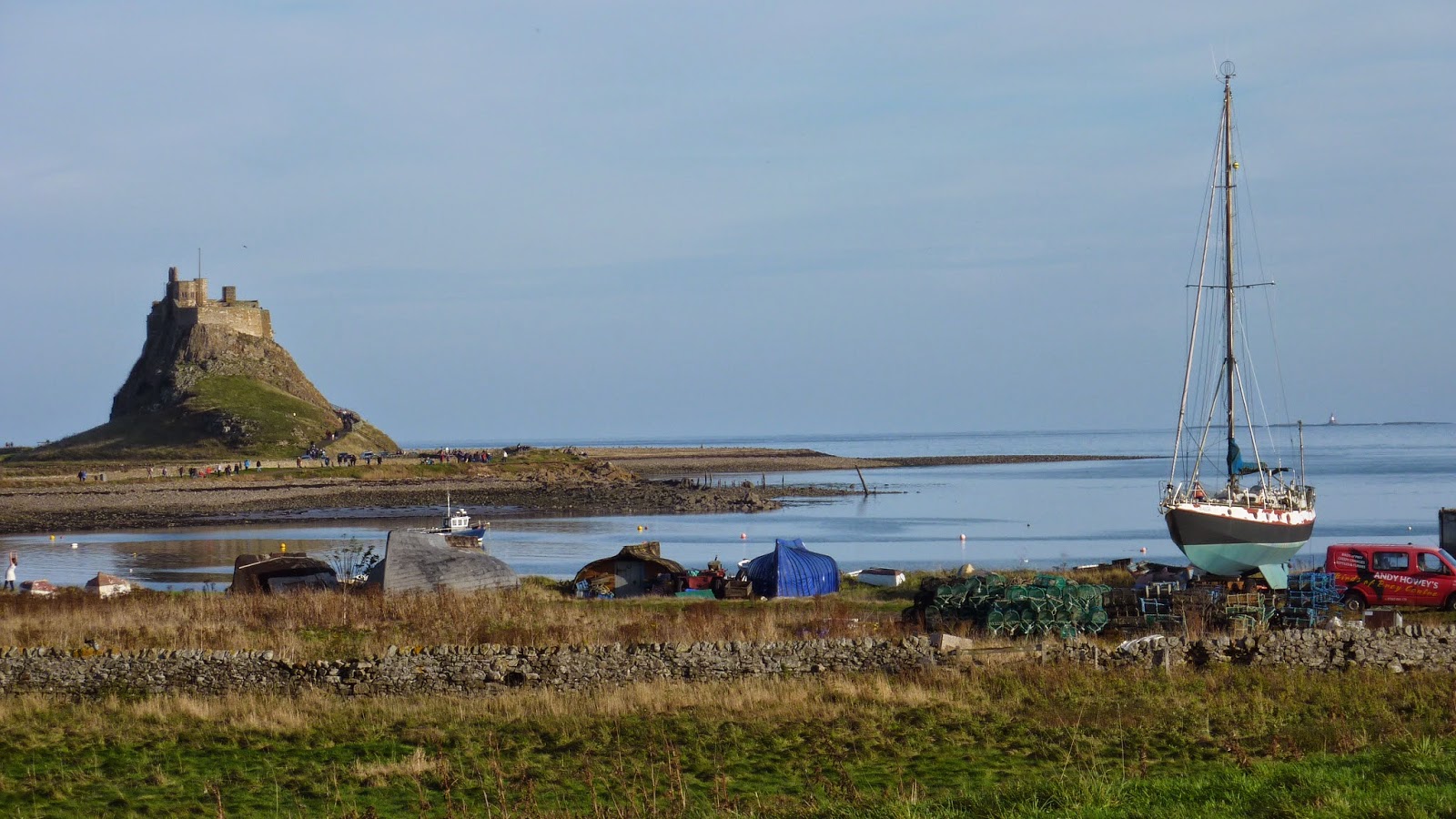
Just back from my first visit to Northumberland in eight years. We stayed at a holiday cottage on the farm at Belford Mains. Bit of a last minute booking, but turned out to be a great choice as the cottage - which was large and comfortable for a family of four, including two teenagers, was in a good location, about 15 miles distant from Alnwick, in the south, and Berwick, to the north. Spent Tuesday under dark clouds in Bamburgh - and when these broke, giving way to a torrential downpour, we bade a hasty -and soggy - retreat to the cottage. Wednesday saw a bright and clear day, so we headed for Lindisfarne under skies of deep, clear blue.


 Sailing dinghy and kayak in Lindisfarne Harbour, with Bamburgh Castle in distance.
We left lunch til late on Lindisfarne, which meant that most of the cafes and eateries were bursting at the seams when we arrived. Taking a chance on the Lindisfarne Hotel, we were amply rewarded with four all-day breakfasts served by a resident double act of waiters-cum-comedians - a great pair of ambassadors for this part-time island and all round mystical land of saints and scholars.
Thursday dawned dull and drizzly, so we headed for Alnwick on the way home. Rather unusually or half-term, we found Alnwick Castle already closed for the winter. The garden remains open. But the £33.00 price of a family ticket seemed rather steep to us. A friend who hales from these parts commented that this was just what you had to expect from the 'grasping Percys', as if one of the richest families on England needs to squeeze any more revenue from the great unwashed visiting its Hogwarts film set castle and gardens.
Best buns in Alnwick? Trotters of Bondgate Within. Bailey's Cafe does a mean BLT as well.
Sailing dinghy and kayak in Lindisfarne Harbour, with Bamburgh Castle in distance.
We left lunch til late on Lindisfarne, which meant that most of the cafes and eateries were bursting at the seams when we arrived. Taking a chance on the Lindisfarne Hotel, we were amply rewarded with four all-day breakfasts served by a resident double act of waiters-cum-comedians - a great pair of ambassadors for this part-time island and all round mystical land of saints and scholars.
Thursday dawned dull and drizzly, so we headed for Alnwick on the way home. Rather unusually or half-term, we found Alnwick Castle already closed for the winter. The garden remains open. But the £33.00 price of a family ticket seemed rather steep to us. A friend who hales from these parts commented that this was just what you had to expect from the 'grasping Percys', as if one of the richest families on England needs to squeeze any more revenue from the great unwashed visiting its Hogwarts film set castle and gardens.
Best buns in Alnwick? Trotters of Bondgate Within. Bailey's Cafe does a mean BLT as well.



Friday, October 24, 2014
A career in recruitment, never listen to anyone again
I've been looking for some extra work and thought I'd try a few of the myriad recruitment agencies that flooded my search results.
They seem to follow a basic pattern: a breathless and urgent promise, followed by ever longer waits for more details - then silence, when you realise they've lost interest and gone onto someone who is easier to place (and easier for them to claim commission).
Now another dimension has crept in, because they've started to email asking if I'd like to work in recruitment myself. Have to admit, after dealing with a few of these over-hyped individuals over the last few weeks, there is a superficial attraction. I mean, where else could I get paid for not paying attention to what people tell me and then trying to fit obviously square pegs into very round holes just for the sheer commission-driven hell of it?
Wednesday, October 22, 2014
Haunted house opposite
The house opposite is now haunted. At least that what the cheap plastic sign, hung in front of the cheap plastic shroud, says. Soon we'll be faced with face-painted tormentors demanding sweets. The American imported spook-fest is upon us once again.
They've not hung a red light in the porch - looks like a knocking shop!
Food tech terror
Five texts, the tone increasing in panic, from youngest son on school bus this morning. He'd forgotten the ingredients they'd been instructed to take in to make carrot buns. The teacher is - according to him - a terror, who shouts at the slightest provocation.
We immediately leapt into action: ingredients weighed and bagged in only a few minutes. Mum now making a considerable detour from her work commute to ensure peace reigns in the Food Tech kitchen area.
I can identify with the sense of panic this teacher engenders because I well remember the three domestic science psychos who kept my cohort of kids in a state of terror. One was a middle-aged friend of Jesus, who used our saviour as her own personal and unseen enforcer. Appearing sickly sweet, she could reduce individual pupils or even an entire class to silence with her quasi-religious line in mind control. Of her two colleagues, one was a large, mainly silent, character who had a corner of her room decked out as a living room - complete with standard lamp and flowery lampshade with a rug and armchair: we took to recreating Monty Python's Spanish Inquisition sketch there if left alone in the room. The third member of this decidedly unholy trinity could go from apparent calm to wailing banshee in the blink of any eye; it was her I thought of as I grated carrot and bagged up the castor sugar. The memory fades but the suffering doesn't. I just hope our efforts were in time, son. I really do.
No schools were named in the writing of this blog to protect both the guilty and the innocent...
Saturday, October 18, 2014
Specsavers make me an offer I had to refuse
Specsavers email a 'friendly reminder' that it's my 'last chance' to complete their customer satisfaction survey. Last chance or what? They'll send someone round to scratch my new glasses?
What is it with the survey meister's need for endless approval of the most mundane of actions? Celebrate our mediocrity, we're just doing our job, but we need your approval to massage our bored egos. Sadly this was an offer I could refuse: Speccy speccy Specsavers, you're opticians - not the Mafia. The kid with the specs doesn't get to make the threats. I know, I've been wearing bins since I was 8. Get over yourselves, and wise up on the marketing. The current model suits you as well as a pair of Dame Edna's glasses.
Yvette on the earhole
A couple of days ago I completed a survey emailed to me by the Labour Party. Have to say, as I read it, I wondered why they - and I - had bothered. The questions were designed to elicit anodyne responses and didn't ask for detailed views about anything. What it did ask, twice, however, was for donations. I declined, and when I hit send, I received a auto generated response from Ed, thanking me for taking part.
Of course, now they have my email, so I thought there would be more. And today, there was. This time, Yvette Cooper, supposedly, emailed to say she wanted a fiver to get more women into Parliament. I responded with a quick click on the unsubscribe button.
You see, I was a party member - but left when the last leader but two took us into an illegal war on the say so of his best mate George, who treated him - and us - like his poodle (remember 'Yo, Blair'?).
If the people's party really wants to engage with its supporters - by which I mean those millions who traditionally vote for it, how about really listening to their concerns, instead of asking questions dreamed up by a bunch of 20-something, probably privately-educated, policy wonks closeted away somewhere in the Westminster village. That, Ed and Yvette, is how to win an election - rather than this self-referencing froth, that really only serves to show how remote you've become from the electorate. Giving the Tories a damn good kicking over the NHS and renationalising the railways would be couple of decent moves in the right direction - as would making sure the national minimum wage was a living wage (get rid of Trident and you'd be able to afford it).
Thursday, October 16, 2014
Pants to your girlfriend
With two male teenagers in the house, we've developed the practice of throwing clean pants and socks onto their beds and letting them out them away.
Yesterday afternoon, eldest son brought new girlfriend home, but didn't tell me. So I, clean shreddies etc in hand, kicked open his bedroom door and launched them at his bed. At which point I noticed son and girlfriend talking (yes, just talking). Managed fulsome apologies before the undertrawlies hit their target, then withdrew to barely suppressed laughter.
Joys of parenthood...
Wednesday, October 15, 2014
Cadets
Time plays tricks on memory – especially when you look back 40-odd years. In my mind, I’m sitting on a coach outside York railway station. It’s a sunny Sunday afternoon in Spring 1977 and the light streaming through the windows is adding to an air of dreamy contentment, the kind that settles after sharing joint endeavour and the talk is of what our group of teenagers have been doing since Friday evening. I’m with a group of Sea Cadets (SCC) from units throughout North, South and West Yorkshire. We’re on our way back from an adventure training weekend on the North Yorkshire Moors. We’d gone up on the Friday and camped behind the Horseshoe pub in Levisham.
The Saturday was taken up with an extended orienteering-style event, walking a set route around the Levisham, Hole of Horcum area, with checkpoints and set tasks to complete. Come Sunday morning, we’d packed the tents away after breakfast and then had the presentations. My team came last – we’d messed up the map reading and missed out a checkpoint. A group of teenaged boys – even those with a modicum of Naval discipline – aren’t the most organised cross-section of humanity you will ever encounter, and a general air of ‘sod it’ had meant that we’d taken a joint decision to keep walking the previous day, rather than try to find the checkpoint and complete the task they were waiting to give us.
But failure was forgotten as we basked in the sun while the Sheffield team got their gear off the coach and headed into the station for the train back home. There was music playing over the coach sound system and my memory serves the song up as Peter Gabriel’s Solsbury Hill, his supposed anthem to the leaving of Genesis. But as a general ode to leave taking it will do to mark a time of impending change for many of us on that coach, myself included. This was May 1977, and I would leave school later that month, returning only for CSE exams (the Certificate of Secondary Education was a relatively short-lived qualification that allowed you to boost your exam marks with course work: a grade 1 equalled an O level, but not many employers seemed to know this, with the result that many who took it unwittingly condemned themselves to a second class qualification. Nowadays, CSEs don’t even feature in those drop down box qualification lists you get on job application websites).
Others were to face greater changes. Initially, I’d wanted to join the Navy, but poor eyesight prevented me from being offered either of my two preferred jobs: control electrician or tactical radio operator, and rather than go with the only alternative on offer – steward – I opted instead for a printing apprenticeship, following a short period working for one of the sea cadet officers who had an electrical contracting business. For several others on that coach, along with friends at my sea cadet unit who didn’t take part in that weekend, careers in the Royal Navy and Royal Marines did indeed beckon. As cadets, we weren’t trained for war, although we did march with some very decrepit ‘drill purpose only’ Lee Enfields and have the chance to shoot .22 rifles at a local TA Centre on a Tuesday evening. Of those who joined up, however, war would come to several of them just six years later: one of my former cadet training ‘shipmates’ would be shipwrecked when HMS Coventry was sunk by the Argentine Air Force on May 25 that year – Argentina’s national day. Another was wounded when HMS Glamorgan was hit by a land-fired Exocet missile two days before the end of the conflict, while a third took part in the fighting on land as a Marine Commando.
The cadets, for me, represented an extension of things I’d grown up with. My dad had fought in WWII and he, along with his friends, had a strange ambivalence to the conflict; there was a recognition of the suffering and loss, but also something approaching a yearning for the closeness and comradeship they’d known as conscripts, forced to face the horror and uncertainty of war. As an only child, prone to bullying at school, and lacking any interest in sport, the camaraderie of dad’s generation was something I found echoes of with the cadets. Membership also brought a sense of belonging and shared identity: a sense of purpose and friends away from the rather lacklustre council estate on which I’d grown up.
For his part, my dad seemed to take a vicarious pleasure in the uniform pressing and ‘spit and polish’ that went with a parade. Chief amongst these was Remembrance Sunday, when I would be treated to illicit under-age beer after standing in the cold and observing the silence.
There was, then, also a class-based air to being a cadet – by far the majority lived on council estates and attended state comprehensives. 11-plus successes were rare – it was abolished by the education committee in my home town for children of my age and younger, and the older cadets who had places at grammar schools seemed strangely reticent about admitting it. Likewise, our officers and instructors were, mainly, from the same background: drivers, police officers, fire service, and the then GPO were the more usual occupations followed by our leaders. I can only remember two who were teachers – and one of those was in charge of the district and lectured at a further education college in Harrogate, well beyond our common field of experience or endeavour.
Being part of the cadets, however, was a thing that set us apart from our school contemporaries. There was the outward appearance of shorter hair for one thing, and the having something else to do two evenings a week and several weekends during the year. On one joyous occasion, I was even granted a week off school in late 1976 to attend a week’s course at RAF Lossiemouth in northern Scotland. I was chosen to go as an instructor and placed in charge of a room that housed around a dozen younger cadets. School mates were envious, and I remember leaving school on the Friday with a new found sense of purpose as I headed for home before being dropped off at my unit to board a coach for the long drive north. There was, as it turned out, little enjoyment to the journey. Around Pitlochry, sometime in the early hours, several of the younger ones developed communal travel sickness, and a Mexican-like wave of hurling went round the coach. One poor kid was held up as the champion puker because his friend swore blind that he’d seen him forcibly eject vomit from his mouth and nose simultaneously.
The days were happy enough to warrant remembrance and reminiscing: there is a thriving community of SCC veterans on Facebook, people for whom, I suspect, schooldays were not the happiest times as they grew up – their fondest memories stem from parade nights and illicit snogs with members of the GNTC, walking to the bus stop or over cups of frothy coffee in late night cafes. Lessons in life dressed up in blue serge or baggy No.8s.
So it is that I see the government’s interest in forming cadet units in schools with rather a jaundiced eye. We have had many years of conflict – near and far away – since I was a cadet; now there is a very real prospect that those who do join up will face participation in the ‘generational conflict’ with Islamic extremism threatened by British involvement in Iraq or Afghanistan. Added to which is the form of cadet service envisaged by our private school-educated leaders. For this isn’t the working class style of the SCC, but rather the private school Combined Cadet Force (CCF), with its Navy, Army and Air Force branches and school-teacher/cum officer corps. The government wants 100 school-based CCF units by September 2015 – a figure that the MoD is now baulking at on cost grounds. They, after all, provide the uniform and kit, even though the government is dipping into the fines it imposed for the LIBOR bank rate setting scandal to fund its militarisation of education. And again, here, there is a departure from the very voluntary model I knew.
Placing the military in schools has been a pet theme of politicians for a while now, not just cadet units, but fast-track teaching training of former military personnel, stand as testament to a desire to instil discipline – or more sinisterly – to ensure a steady stream of recruits at a time when unemployment amongst the under 25s is stubbornly refusing to shrink to manageable proportions. Another, perhaps more fanciful explanation, could lie in the advanced aged of Conservative voters. An injection of younger people, who have learned to ‘know their place’ on the playground-turned-parade ground of the CCF could be just the thing the Tories need to fill the gap as their older voters – like old soldiers – fade away.
Sunday, October 12, 2014
Hack Attack by Nick Davies
The full account of News International's hacking and other illegal information gathering activities. Written by Nick Davies, freelance journalist and long time Guardian contributor, Hack Attack also charts the lengths to which Murdoch - both Rupert and James - demanded 'no-holds-barred' journalism (as exemplified by the widely used injunction 'whatever it takes to get the story'), and the corrosive effect of their use of power, threat and patronage to befriend and threaten elected politicians, as decreed by Rupert and his senior lieutenants, such as Kelvin McKenzie and Trevor Kavanagh. Davies is honest about the shortcomings and failures that beset his investigation; he also raises the terrifying spectre of a resurgent tabloid media that was all too eager to trash Leveson and hide behind freedom of speech to resume its prurient spying on those who threaten its lack of ethics or basic morality or allow it to sell papers and news subscriptions with 'stories' that exploit the weak or chew over the foibles of public figures or transient celebrities..
Saturday, October 11, 2014
Digitising my past
A scanner, laptop and a pile of old photos. Just been 'admitted' to a Facebook page set up for members of an organisation I joined in my youth. Now on verge of tears - so many memories flooding back. Must pull myself together - they're only pixels after all. And I'm not that old, in spite of what teenaged sons might say...
Friday, October 10, 2014
One in the eye for me
I had an eye test the other day. In addition to myopia (been wearing specs since I was 8), I also have to be tested for glaucoma because my mum had it. This involves sitting at a machine that puffs a shot of air onto your eyeball to check the pressure ( the correct ophthalmic name is tonometry). Now, I'd always thought that the person sitting on the opposite side of the puffing machine administered the puff by pressing a switch or button. Indeed, I have to admit to rather envying them their role: being able to add an extra one 'for luck' if faced with a particularly stroppy or annoying patient would be a great perk of anyone's job. Not so. The pleasant woman who ran the test for me, and apologised after each puff, told me the entire process is automated; the puff is triggered when the eye is fully opened. So why was she sitting there? Do they record reactions and play the best ones back at break time?. Didn't ask. After she'd blown the gaffe about the automation, the process lost some of its magic for me. The strange thing is, no matter how many times a person has the tonometry test, she said they always jump. Unpleasant the sudden shock of forced air to the eyeball may be, if it diagnoses glaucoma, keep on puffing, I say.
Tuesday, October 07, 2014
Beware of Geordies selling private health insurance
And today, another call from AXA PPP 'on behalf of MYCCI'. So I ball them out and send an angry anti-cold calling, anti- selling my details on without consent email to MCCI. Now for the ICO website.
Anecdotal evidence suggests that, amongst the call centre fraternity, a Geordie accent is regarded as the most trustworthy. Well, I've just been called by a Kevin Whately soundalike who wanted to tell me all about the benefits of AXA private health insurance. Before I bade him Auf Wiedersehen, he managed to tell me that my details had been passed to him by the Mid-Yorkshire Chamber of Commerce. All rather strange, because, apart from attending a seminar they organised a few months ago, I've no connection with MYCCI, as it styles itself, and certainly no recollection of giving my consent to receive exciting marketing waffle from their, no doubt, 'carefully selected' partners.
Do hope MYCC aren't acting in breach of data protection legislation, as my natural antipathy to private healthcare could trigger a reference to the Information Commissioner if I receive any more 'exciting' cold-calls attributable to them.
Friday, October 03, 2014
Appreciated, valued, deluded and underpaid
According to a piece of professional development drivel I just came across, people who are 'appreciated' work harder. The capacity for self-delusion amongst the horny-handed toilers never ceases to amaze me. Having been told for years that unions are evil, that any form of collective expression of dissatisfaction is wrong, it seems we now have a generation of workers that feel beholden to those who employ them or commission them to work - is it any wonder that pay rates are, at best, stagnant?
The best way to show appreciation for work well done is to pay for it properly, and on time (if performed by one of the growing ranks of the self-employed).
Recent years have seen a growth in CPD as a means of ensuring that skill levels remain relevant across a whole range of sectors, but - hand-in-hand with this - has been the insidious spread of a species of management-speak that constantly chips away at the need to pay well (or even at all - witness the growth in reliance on volunteering or the apparently unstoppable rise of the unpaid interns). There is clear danger here: by denigrating concern about pay levels, we are creating an underclass of impoverished workers, at a time when management sees its pay levels increase out of all proportion to those they employ. We need politicians and economists to demand a far greater correlation between the two - and soon.
The wild (city)rover
Owing to a car service that necessitated an overnight stay in the garage for our somewhat venerable Fiat Punto, I ended up with a Cityrover courtesy car. Cityrovers, for those not familiar with the marque, were built at Longbridge between 2003-2005 and, rather incongruously carry the Rover badge.
Now, in my youth, Rovers were a beast of a car: John Thaw's Jack Regan drove one menacingly around London's badlands every week on the Sweeney and every hard-bitten (plus quite a few soft-boiled) 70s sales reps probably gave their eye-teeth to get behind the wheel of one. A Cityrover, by stark contrast, is a rattle-wagon with an under-powered rubberband engine and doors that give the adjective 'tinny' a bad name.
In short, driving from home to Yeadon and back was a trial. The experience was made worse on arriving at work as, for reasons best know to the manufacturer, this car is fitted with an alarm and immobiliser of fearsome proportions - far in excess of the vehicle's worth - and which I managed to set off while trying to lock the damn thing.
My humiliation was not quite complete, however. On leaving the office, and making the most of the non-powered steering to wrest the thing out of its parking bay, I was treated to a look of such superiority and contempt by the man behind the wheel of a sleek, brand new Merc (64 plate for UK readers) who was just pulling into the car park.
Cityrover - experience the true feel of 1970s British auto engineering: coming soon to a scrapyard near you.
Thursday, September 25, 2014
Recommended reading?
I bought Nick Davies' expose of high crimes and misdemeanors in the evil Murdoch empire Hack Attack on Read Now app, which has just recommended Mein Kampf for 74p. I knew Rupe was a thoroughly-bad egg, but didn't have him in the same league as Hitler. One recommendation I won't be taking up.
Friday, September 19, 2014
Guinea pig bereavement
Peppa, one half of the duo of sows we 'adopted' in April died in her sleep on Wednesday night. At six-and-a-half this was not entirely unexpected. Cheeky and playful to the last, her version of raging against the dying of the light was to stage an audacious dash for freedom when being moved from the run to hutch for what proved to be the last time.
Her partner, Salt, at three, and with a far more nervous disposition, has gone through a complete transformation in behaviour. Where previously she'd run away if we approached, even bearing food, now she just sits and looks vacantly into space, she is also now content to sit on a lap and purrs when stroked. I think we will soon be looking for another adoptee.
Saturday, September 13, 2014
Thirteenth birthday bash, where's the antacid?
Youngest son celebrates thirteenth birthday tomorrow, so tonight - as requested, we have a sleepover preceded by an outing to KFC. Hope sleep comes early, and the heartburn inducing deep-fried grease fest doesn't mean I'm the one who can't get to sleep til the wee smalls...
I Am Pilgrim
Enjoyed Terry Hayes' debut novel. Bit too James Bond in places but a good espionage tale nonetheless. Looks like a film's planned, so see what the movies make of it. Decided to follow it up with Le Carre's Most Wanted Man. Might not get to see it at cinema so soon after its release bit really enjoy his writing in any case. Sad to see it's Seymour Hoffman's final leading role.
Dead flies and a dead shredder
Just seen off the second shredder of the year. With the sheer volume of paper that contains names, addresses or even hints of bank details needing to be disposed of, you'd have thought they'd built to last. Them again, perhaps weakness makes up for the lack of built-in obsolescence in the damn things. Either way, it's another 25 quid down the drain. At least it keeps the guinea pigs in bedding.
And now, as the nights draw in, the time has come for Autumn's least likeable task: removing dessicated fly and moth remains from the conservatory roof blinds delicate folds... All hail the season of mists and mellow fruitfulness, and crispy creepy-crawly corpses.
Monday, August 25, 2014
Choking in praise of Wensleydale
Over dinner last evening in Ziggy's Indian restaurant, Halifax, my eldest son regaled us with the news that one of his scout leaders had, earlier that day, cycled from his home in Sowerby Bridge to England's highest market town, which is situated in Wensleydale, an are I love to visit. Indeed, so caught up was I in the moment that I immediately ejaculated the highly ambiguous phrase 'I like Hawes'.
Cue coughing fit and mirth from spouse and offspring.
It's great when you can embarrass the kids in public...
Tuesday, August 12, 2014
Family walk in the Dales? That'll be £14, please
Went to Ingleton today as a family of four looking forward to the 4 mile walk that takes in a couple of dozen waterfalls and some fine limestone scenery, all in the majestic shadow of Ingleborough. There's always been a charge for this, as most of the route is admittedly over private land. However, we were unpleasantly surprised to find the price had been hiked to £14 for a family ticket! Time for another mass trespass?
Saturday, August 09, 2014
Fear and loathing - religious bigotry in west Wales
Leaving the Gatehouse after visiting St David's Cathedral, in the smallest Welsh city of the same name, I was handed a double-sided, closely typed A5 sheet. The bearer was wearing cycle clips, which I probably should've taken to be a portent of obsession.
The message contained on the sheet, and reinforced by a disparate collection of biblical quotes ranging from Genesis to Timothy, although all held together by the drivel that is Revelation ('the happy hunting ground of heretics and schismatics' or 'I don't know what the writer was on at the time they wrote it, but I wouldn't want to be caught coming through Customs with any...': two blistering counterblasts I once heard a baptist minister deliver against the final New Testament entry).
The text starts by stating that God has made Israel his 'battle axe' to destroy all 'His and Israel's foes', so you know straightaway that were talking fundamentalist Christian support for Israel's stance on Gaza. Interestingly though, Islam isn't mentioned by name as one of the 'human anti-Christs' to be destroyed by the divine battleaxe. Rather the writer states that Israel is now 'surrounded by enemies' that want its destruction. These are all lumped together as 'Satanic'. But if Islam is only hinted at, others aren't so lucky - because also lined up for a bit of battleaxe smiting action are Jehovah's Witnesses and anyone that practises transcendental meditation (looks like some personal issues crept in at that point: still, must be hard to stop, once the smiting urge grabs you). To sum up the message: taking a string of biblical prophecies and eschatological texts (ie those dealing with the end of the world/judgement day/Armageddon, etc), written between 2,000-3,000 years ago, the author is using the Old and New Testaments to justify the violence and death being visited on Gaza by the modern-day Israeli state. In this context, the author's antipathy to Jehovah's Witnesses is interesting, because they too are heavily influenced by a belief in the 'end times' (which to them started in 1914 and will culminate with a cataclysmic final battle - literally Armageddon). This belief that 'the end is high' is also shared by several other sects and even some 'mainstream' fundamentalist evangelicals, and the author of this text is clearly motivated by a desire to hasten the 'end' by talking of modern-day Israel in Old Testament prophetic terms: this isn't a focus on the suffering of either Israel or the Palestinians, but rather an attempt to exploit the suffering for decidedly millenarial ends.
The bible isn't always on the side of the foam-flecked, however, and instead of using Rev as the mortar to stick disparate pieces of biblically inspired intolerance together to justify the violence that has caused so many child deaths in Gaza, it would have been better to turn to Micah, Chap 4. Best known as the bit in the bible that wants to turn swords into ploughshares, it goes on to say that all should live in peace, each under their own figtree. Now there really is a quote worth reminding Israel - and all those who sell it weapons - about. Could also be used as a British value, if Mr Cameron really wants to show some leadership.
Micah appears to have lived at a time when - as now - tolerance and peace were in short supply in the Middle East. The writer's response was to pen a phrase that stands in stark contrast to those who filter scripture to bolster calls for war. In Chapter 6, in answer to the question 'what does God require of you?' there is the simple reply: 'do justice, love mercy and walk in peace with your God'. Effective, straight to the point, and certainly beats peddling hate outside cathedrals/chapels/mosques/churches/temples et cetera, passim, ad nauseum.
Llandudno, twinned with Devizes?
Twin Llandudno with Devizes
An Orme so small, hardly no Orme at all
But another so big it wins prizes.
Friday, August 08, 2014
All together now: serving food the family way...
Might sound rather old-fashioned, but my family of four likes to eat together, sitting at a table, but here on holiday in south-west Wales that's proving rather difficult. In pubs and cafes over the past week, we've had food delivered at intervals, so that some sit eyeing up the dish in front of them, while neighbouring sibling or parent twiddles their thumbs. It used to be standard practice to assemble and hold all one table's dishes in the kitchen so they could be served together. Now, food delivery seems to focus on each individual dish, so that eating is staggered - even between members of the same party, who ordered their food at the same time. And it's bloody annoying.
The perils of falconry
Caught a falconry display at Pembroke Castle. A couple of Harris hawks put through their paces by a falconer from Abergavenny with a nice line in slightly politically incorrect patter. Come the grand finale, however, and the anticipated peregrine flying display fizzled out when the bird flew off over the castle walls only to find chasing seagulls preferable to entertaining the crowd, which left, leaving lone falconer climbing the castle walls shouting 'Quack Quack' - the bird's name, but surreal nonetheless.
Estuary-side holiday let
Neyland, Pembrokeshire. The letting agent insists on calling the three-bed semi we've rented for the week a 'cottage'; it isn't.
It's comfortable enough, although the claw-footed bath with ersatz rubber shower hose attachments is rather impractical. We're also next door to a masonic hall. The bowler and pinny brigade haven't shown up yet, but I'm on the lookout for rolled-up left trouser legs.
Tuesday, July 29, 2014
Telegram from Guernica, biography of George Steer
In which Churchill's recorded as being in favour of using poison gas against native uprisings. Mussolini got there first though. War in Ethiopia was orchestrated by Italian fascist regime and used copious amounts of the stuff against poorly equipped Ethiopians.
Summer, the first time...
Last Saturday, with my wife out shopping and eldest son skateboarding with his friends, I rashly asked my 12-year-old if he would like a barbecue. Not keen myself: risk of eating raw meat and amount of cleaning up afterwards, but he was very keen to take up the offer, so burger and sausages in hand, and charcoal nearly alight, the cooking commenced.
Soon afterwards, there was a call from the first-born, could he and his friend AND TWO GIRLS also attend the charred meat fest? The upper case letters are there to denote a first: we haven't had a request for teenaged girls to join us before - my youngest son was horrified, and immediately said he would be eating inside (girls to him are classed as 'annoying' - the vast majority; or 'OK' - which means the like to play football and go nuts in the park with him).
I declared the barbecue open to all - with the proviso that eldest son procured either more sausage or burgers as we didn't have anywhere enough for six people.
The four newcomers duly arrived and I was amazed when the girls ensured eldest went for the extra food without my having to issue the request more than once, and took the lead in arranging an impromptu al fresco experience on the decking. Mind you, youngest still thought they fell in the 'annoying' category, they didn't eat any of the salad or offer to help with the clearing up. Still, a major civilising influence and a neat, yet determined, counterbalance to the usual testosterone-fuelled, YouTube video-watching staple of teenaged male-only mealtimes. They can definitely come again, no matter what youngest son says...
Monday, July 28, 2014
Know your place
http://www.amazon.co.uk/Sense-Place-David-Hyatt-ebook/dp/B00M6ZW3PC/ref=sr_1_1?s=books&ie=UTF8&qid=1406576153&sr=1-1&keywords=a+sense+of+place+hyatt
Tuesday, July 22, 2014
Patterson and Gove and the blobbies
First Gove derided one, now Patterson has blamed one for his ministerial demise. Both criticised 'blobs', environmental or educational establishment groupings that stood in the way of their pet theories. But delving into the alleged constituent parts of their respective blobs, a different picture tends to emerge. Take Patterson's Green Blob, where we find pressure groups - like Greenpeace and other lobby groups, the Green Party, and a vague identification of others opposed to Patterson's climate change beliefs. These aren't the dangerous elements he describes, but rather those concerned enough to take stand against the arrogant/ignorant stance taken by ministers convinced as to the rightness of their cause, but lacking the empirical evidence for their frequently dogmatic assertions. It's not the blobs we should fear, rather the unchallengeable assertions of Tories with unshakeable views that don't stand up to reasoned argument. Bet IDS has a lot of blobs.
Monday, July 14, 2014
The Girl Who Saved the King of Sweden
Really enjoyed this surreal romp through 50 years of geopolitical history; even made grim, apartheid era South Africa funny. And the king even appealed to Republican me http://www.harpercollins.com/9780062329127/the-girl-who-saved-the-king-of-sweden
Monday, July 07, 2014
Zut alors; French cops on English streets - a Mail reader's nightmare
Along with 2.5 million others, I managed to catch sight of the peloton as it made its way through God's own country at the weekend. As I left Mytholmroyd train station to walk up the hill to Cragg Vale, the longest continual incline in England, I noticed a line of deckchairs on a grass verge, every single occupant of which was engrossed in the Mail on Sunday. Thought at the time that this was one of those quaintly British paradoxes at work here: a group of right wing media consumers out to watch a bunch of mainly foreign bike riders race past them.
It was only an hour or so later that I realised they faced a threat to their well-being from the pre-peloton 'caravan' itself. By then waiting outside the Robin Hood pub, the first outriders appeared, but they weren't British bobbies on motorbikes, rather French Gendarmes or Police Nationale, and they kept on coming, either on high-powered bikes or in minibuses. The platoon of MoS readers must have been driven to apoplexy, I thought. Soon afterwards, I heard the wail of a siren, only for a Mountain Rescue Service ambulance to drive past, down the hill in the direction of the station. I learned later that it was called to treat someone who have fallen off a wall, not to defibrillate a MoS reader who'd been driven to cardiac arrest by the sight of so much French motorised law enforcement. This was probably a good thing, because the ambulance itself was Irish - first aid for the Tour being provided by the no doubt excellently equipped Dublin and Wicklow Mountain Rescue Service - Erin Abu.
Thursday, July 03, 2014
Ofsted inadequate
Son's school has just had an Ofsted inspection that shows - achieving academy status AND opening a 'free school' FE vocational centre notwithstanding - that it's gone from a 'good' community high school to being so inadequate, across all four inspected areas, as to be placed in special measures.
All this decay took place against a veritable deluge of supposed good news stories pumped put at regular intervals via email and paid for mailshots. Strange, then, that notification of the Ofsted inspection was by way of a letter handed to pupils to bring home. Being suspicious by nature, I now wonder if they hoped to ameliorate the potential flow of bad news to the inspectors by using the least reliable method: after all, the Ofsted report itself mentions the low number of parental submissions. There's a parents' forum taking place in an hour, where I'm really hoping that serious questions will be answered, particularly regarding the findings of inadequate teaching in KS3 and 4 and the inadequate finding for pupil behaviour and safeguarding. But then again, perhaps I shouldn't expect too much, after all, in the (mailed) letter inviting us to the 'forum', the headteacher assures how keen they are to embark on their 'improvement journey'. From Michael Gove preserve us...
Sunday, June 22, 2014
Virgil Tracy lives on our street
The electric double up-and-overs hide his island of neat
Each tool and gadget is easily to hand
Thuderbird 2 has been swapped for a white van.
Hours spent wall-mounting, storing and ordering
Unlike the rest of us unprepared tool-fumbling dimwits
He knows anything could need fixing in the next 30 minutes.
Saturday, June 07, 2014
A problem in the trouser department
When was it decided that button flies were back in fashion? What will they bring back next - night soil removal? Rickets? I know UKIP and the Tories want to take us back to the fifties, but hadn't realised zips were on the list of things they disapproved of, along with social security, the NHS and human rights.
Wednesday, June 04, 2014
Assessing insurance claims
Time was if misfortune or accident struck, you called your insurer and left it up to them to sort put estimates and costs. That's what insurance companies did. But then, insurers realised they could cut operating costs by turning themselves into call centres, which handled the initial contact, and sent out premium reminders - which have now morphed into egregious auto renewals, complete with nasty, unexpected direct debit bills. The difficult site visits and dealing with builders, mechanics, car body repairers, etc being farmed out to loss adjusters.
The insured, having notified the insurer of a claim, would then deal with someone from a different company, who sorted out the costs and expenses and instructed the repairer. But now, yet another entity has interposed itself between insured and insurer: the claims or loss assessor. Once a claim comes into existence, these bottom-feeding ambulance chasers use divers means, including, apparently, payments to emergency service personnel, to discover the identity of the insured, and then hasten to 'sign' them up, by getting signatures to a contract that allows the assessor to 'manage' the claim on the insured's behalf, in return for commission payments from the repairers they obtain permission to use from the loss adjuster.
In reality, however, the assessor is doing nothing the insured couldn't do in person, and adding yet another party into the equation also increases the time taken to put right the damage caused. Unnecessarily complicating the claims procedure adds to adminstration cost and that forces up premiums, meaning that we all lose, due to the resistable rise of the loss assessors.
Sunday, June 01, 2014
Happy Anniversary
The picture was taken 100 years ago today - my grandparents married at St Andrew's Church, Burley, Leeds on 1 June 1914. Just 27 days later, the heir to the Austro-Hungarian throne was assassinated in Sarajevo - a place that most of the people in the photograph would never had heard of. But by the beginning of August, WWI was declared and within 4 years my grandfather would be fighting in Flanders and of his two brothers, Arthur would be a prisoner of war in Germany, and his youngest brother, Albert, would be dead - killed in an air raid at Ypres.
Of two of the male cousins in the photograph, one would lie about his age to enlist and another would endure the opprobrium and ridicule reserved for the conscientious objector.
Before the public displays of remembrance start, I want to offer my family as an example - on this, the centenary of my grandparents' wedding - as a reminder of what war did to ordinary people, and how they coped with the horror of events way beyond their experience or control.


Subscribe to:
Posts (Atom)