Sunday, July 28, 2019

Taking the cure at Fountains Abbey

River Skell seen from Surprise View, quite a climb but worth the effort for the view of the Abbey in the background


The Lake, with Fishing Tabernacles either side of the bridge - the Valley of the Seven Bridges is away
 to the bottom left of the picture

The Watergarden.


 The place is so very special because my Dad took me there as a child. He used to go on holiday to Ripon, where his grandad was a gentlemen's hairdresser (he didn't like the term 'barber'). At one time his three sons - my grandad, his two brothers Arthur and Albert, along with his half-brother Edgar, all worked in the business. Albert was killed at the end of  October 1917 near Ypres, while Arthur was badly wounded in a mine explosion on the Western Front.
He was rescued from the carnage by a German patrol. Taken prisoner, he had to have extensive surgery, which led to him losing over half his stomach. Arthur, who never married, returned home to Ripon, where he took to wandering late in the evening and during the night - Studley and Fountains were his favourite stamping grounds, and I like to think that here he found peace after the horror, loss and suffering of war.


             Cure of Fountains
In the Chapel of the Nine Altars by moonlight
And in the Valley of the Seven Bridges at dusk
Arthur, a man scarred by war and captivity
Chooses to walk alone and in peace

Under the ruins of the great tower
And by the fishing tabernacles
His cares and pain are eased by
The beauty of ancient tranquillity

Here gods and Greeks and Aislabie’s folly temples
Wrestle for attention in the moonlight and cool
Of evening shade
And the curse of war is banished
By Arthur’s nocturnal wanderings.
 
For more of my family history, the life story of Ripon's oldest Barber and a 100-year-old mystery, read Heirloom.

Thursday, July 18, 2019

It can be murder in Argos...

Called into our local Sainsbury's yesterday to pick up a pair of long-handled shears I'd ordered online from the instore Argos operation. I gave the order details to the guy behind the counter, who disappeared into the back. He returned a couple of minutes later with the shears and hefted them by both handles before putting them on the counter, saying 'they're heavy - you could cut up a body with them'. Feeling the need to reduce the mood of pending homicide that I sensed after his comment, I said I'd bear that in mind but was only planning to use them to trim my lawn edges, at least for the time being. I know retail can be a stressful environment, but left the store wondering if this was some new HR initiative to cut out the need for those signs reminding the more out of control shopper not to be abusive to the staff?

Monday, July 15, 2019

Change for a Fifty?

Welcome as it is that Alan Turing's face is soon to adorn the £50 note, can't help if this is going to prove a 'hidden' honour not at all worthy of the man. After all, when did you last hold a £50? Many shops and pubs refuse to take them: is it just an empty gesture - and one that's far too late? Turing's work is credited as shortening WWII. Think about that for a moment - especially if your dad, grandad or great grandad came back safe. There's countless thousands of us - myself very gratefully included - who a possibly alive today thanks to Alan Turing. Putting his face on a fifty seems rather unambitious. His birthday should be a national holiday; Whitehall should be renamed; and the anniversary of his prosecution should be marked with at least a minute's silence so we can collectively recognise the hero who was persecuted, when he should have been honoured.

Friday, July 12, 2019

Three questions for our time

OK, so these probably just serve to confirm my decent into old fartery, but I have to ask: 1. What's the point of blueberries? They don't taste of anything except sugar and when baked turn into a purple stain; 2. Why do deodorants need a 'safety catch' all of a sudden? When was the last time you accidentally shot yourself in the armpit? 3. Why can't new cars have proper handbrakes? Flipping a little switch doesn't give the same sense of secufryt and driving away with the brake still ostensibly 'on' just feels weird.

Saturday, June 22, 2019

Breakfast in the garden

And someone nearby is doing the same. But his phone's on speaker and I'm getting one side of his lifestory over my fruit and fibre. Arghghhh.

Wednesday, June 05, 2019

Europe's liberation, in dates and song.

Started with the landings in Sicily on 10 July, 1943. Or if you want to be pedantic about mainland Europe, 3 September 1943 at Reggio in Calabria, southern Italy. My father took part in both. And after D-Day, when Lady Nancy Astor castigated the Allied forces in Italy, who'd been sent by Churchill with the understatement of the war in that they were going to attack 'the soft underbelly of the Axis crocodile', saying they should be sent to the real war in Normandy, revelled ever more in the self-deprecating soubriquet of the D-Day Dodgers. It was a long and bloody campaign; doesn't detract from the bravery and sacrifices of D-Day and the long push east to Germany, but Normandy 1944 wasn't the first step in Europe's liberation.

Freedom Anniversaries and the Shadow of Tyranny

75th anniversary of D-Day and the 30th anniversary of Tiananmen Square falling in the same week make me think of that guy and the tank. At work back then, we mocked up a poster, with a speech balloon borrowing the Viz Parkie's slogan, so that it had the bloke with the shopping bag shouting 'right, now fuck off' at the tank. I also vividly remember sitting up most of the night the Berlin Wall came down on October 3, 1990 with friends, including a German student who was sharing the house in Bradford. She was in tears as the crowds streamed both east and west as the VoPos stood meekly to the side of the gaping holes hammered into the concrete blocks. After a lot of drink and emotion, the night ended with a drunken karaoke session to the WolfeTones' rendition of A Nation Once Again. Different country; longer and continuing separation; but the sentiment seemed fit for the occasion. As indeed did the end-of-Iron-Curtain 'classic', Winds of Change by the German band Scorpions. German rockers with dodgy English pronunciation (maagik??) capturing the zeitgeist - would've of thunk it? And who indeed would've have thunk that - just under 30 years on - we'd be faced with the divisions of populism and nationalism, instead of the glories of freedom that were promised. Defeat snatched from a promised victory of peace by the old emnities, distrusts and hatreds from the past. Liberation and freedom have been stolen and used contorted to justify selfish isolationism and bolster the Xenophobe. It all seems a long way indeed from the hope and promise of D-Day and a betrayal of the lives lost in the fight for freedom from Nazi tyranny.

Sunday, May 12, 2019

West Yorkshire places of interest on the Peninne Way

Lumbutts and Mankinholes: two real places that sound like sadomasochistic practices only to be attempted between consenting adults with a recognised safeword.

Thursday, May 09, 2019

Caught short in Scarborough

Scarborough's public loos now charge 40p a visit. But don't worry if you haven't got the change, you can go contactless. Payment shows on your card as being made to NYX*Healthamatic. These people really are taking the piss...

Australian proofreading responsibilties

Typo on 46 million new ASD 50 notes. Someone has to carry the responsibilty for this? https://www.bbc.co.uk/news/world-australia-48210733

Wednesday, May 08, 2019

Chinese consumer protection: how Banggood went bad.

I've made a couple of new online friends, Phenix and Kelvin. It's unlikely that we'll ever meet face-to-face as they live (or certainly work) in Guangzhou, China. They are employed by the Chinese-based global online crapola outfit, Banggood, which specialises in churning out cheap rubbish that is misleadingly - or even fraudulently - advertised online. The ads are pushed via Facebook and other social media, so you appear to be 'chosen' - targetted might be a better description - to receive them. The catalyst for the interesting range of emails Phenix, Kelvin and I have been exchanging concerns this garment
, which Banggood described in the ad they 'selected' for me as a winter corduroy coat. Now, I once owned a very warm and capacious corduroy coat, made from heavy weight cotton corduroy, with warm and generous insultated padding and thought the advert was describing something similar. I've never been to China, but I know winter there brings temperatures far lower than ours in the UK and felt sure the coat would be a real bargain at the advertised price of GBP 28.86. But things were not to be as good as they were promised. When the garment arrived, it turned out to be something more on the lines of a shoddily made shirt. No padding, or even 'real' corduroy as it is 90% polyester. Now, with goods that don't match their description, under UK and EU law, we have a remedy that allows us to claim a refund and for the supplier, usually, to carry the cost of return. But things played out rather differently once I told Phenix and Kelvin about Banggood's porky-pie ridden online advert. For a refund of GBP 9, I would have to pay the return postage! Nice try, I thought, but not really what I wanted to hear - after all, this was as blatant a case of intentional misleading advertising that you could come up with, and one where Banggood were expecting me to either accept the crap, or make an unintentional GBP 19.86 'donation' to their coffers. The bad guts don't get to profit from their wrongdoing - pretty much a cardinal principle of Western consumer law, but one where China has some catching up to do. In the meantime, don't get suckered by Banggood's push ads.

Wednesday, May 01, 2019

Peacock meets the bin lorry

For past couple of days we've had a peacock 'visiting' our corner of West Yorkshire. It's a newish housing development, so a large brightly coloured bird does stand out as it struts rather imperiously between gardens and open plan areas. Today is bin day, and by the amount of shrieking and clattering - from bird and bin crew respectively - the former doesn't like the latter very much at all. Perhaps the peacock will move on, or stand its ground against the rubbish devouring monster (presumably part of its anger is due to the loss of a good food source). Whatever the outcome, it's far from quiet in the 'hood right now.

Wednesday, March 13, 2019

Brexit gammon fallout

'It was awful. He was sat watching the voting in parliament, then his face went all red and he shouted something about spitfires and the White Cliffs of Dover, and then he just burst into flames. The Parker Knoll's ruined'.

Monday, March 11, 2019

Returning to the Greengrocers

I first read Living in Truth, a book of essays by and about Václav Havel that was published just after the Velvet Revolution which brought him to power as the President of post-Communist Czechoslovakia in early 1990. Havel was a fascinating figure. A playwright who lived most of his life in Prague, he became a well-known dissident during the darkest days of repression after the short-lived Prague Spring of 1968. He was imprisoned by the Soviet-backed puppet regime led by Gustáv Husák (to whom Havel – cheekily – addresses the essay that was to become the first chapter of Living in Truth, about the long-perceived shortcomings of the regime). Later, Havel become the leading voice of the Czech human rights group Civic Forum – for which he would incur yet more official disapproval – but which would propel him on to a much wider stage as a leading advocate for reform. Havel believed, at the time Living in Truth was published in 1985, that the totalitarian regimes of the former Soviet satellite states – along with that of the Soviet Union itself – had effectively run of out steam, and he, along with millions of others, were living in a ‘post-totalitarian’ period, when people would start to ‘live in truth’ again. What he didn’t foresee, however, was that the end was to come a lot sooner than he believed when he started writing. Barely four years after the essays were written, Havel found himself propelled from dissident and former prisoner to the highest office in the land, and all without a shot fired in anger. It’s the second chapter, ‘power of the powerless’ that I remember best, largely because of the story of the greengrocer. In this chapter, Havel describes the actions of the manager of a fruit and vegetable shop, who – along with many other sales outlets at the time – was expected to display signs extolling the virtues of Maxist-Leninism with their wares. In Havel’s version, the manager has to display signs, with slogans such as Karl Marx’s rallying cry of ‘Workers of the world, unite!’ or ‘socialism is the light of a child’s smile’, in amongst ‘the onions and carrots’ so that they blend with the everyday. Failure to do so, Havel goes on, could lead to the manager being officially reproached for not having the proper, approved window decoration – a failure that will be noted and could be held against him at a later date. But Havel then explains that the signs are ignored, they have no meaning, no-one – probably the manager least of all – actually believes them anymore. They are merely going through the motions of putting them in shop windows, and shoppers pay no attention to them whatsoever. The command to display them is part of the hollow rhetoric of a repressive, out of touch, and increasingly hated power structure. I can’t remember my first response to the story, perhaps I thought it was just one more stupid manifestation of totalitarianism; mind control of the masses, but something that showed that such control was essentially futile. I certainly would have felt that it would never happen in the ‘West’. Yet the story of the sign was not destined to stay among the onions and carrots in my mind. Fast forward 30 years and the otiose signage of totalitarian eastern Europe has now spread like onion blight and carrot fly throughout privatised industries and global economies. Equally pointless exhortations are laid before us in the name of professional development and human resource management (a phrase in itself redolent of repressive power control). We are now required to display the thinking of ‘owning’ our work, or to take team building and commitment to banal –even at times farcical – extremes. We might ignore messages like ‘team work makes the dream work’, but failure to display means we’re not accepting of our place in the hierarchy; a crime to be recorded and for which expiation will be demanded at the next appraisal, or kept on file for future reference, or even references. The ‘power’ of the powerless that Havel uses in the title is the essential power of dissent: the right to be able to say that the emperor is, in fact, stark bollock naked, without fear of repression or harm. That is what is necessary for a return to sanity in public and political life. The rise of populism, along with the derision heaped on empirical evidence, exemplified by Michael Gove’s ‘having enough of experts’ will have to be countered at some point. The alt-right and right wing elected politicians will have to be faced with the reality of their ill-thought through utterances. Not even President Trump can evade responsibility for the duplicity and danger created by double-speak, distortion and populist excess tub thumping. For there will come a time when ‘great’ will become ‘grate’ in his favourite red baseball cap slogan. And when that reckoning comes it will owe much to Havel’s belief that extremism can be defeated by the truth that has to be lived by each and everyone who has been damaged or denied by the politics of division and empty rhetoric. I recently saw an ID lanyard around an employee’s neck which carried the slogan: ‘I never settle for good enough’. Never, really? Not even when you’re running late and the kids need collecting from after school club, or when you’ve arrived at work angry and upset after a row with your partner? It insults the intelligence of the wearer and anyone who reads it. Instead of giving credence to the slogan, my thought was that this person’s thought processes have been commandeered by their bosses, an insult to her intelligence and the collective wit and understanding of herself and her work colleagues. Milan Šimečka, Slovak Philosopher and friend of Havel’s, described this form of propaganda as ‘the big insult’, which he defined as ‘a situation where intelligent people have to listen to bunkum and talk bunk, fully aware that it is bunk, because otherwise they would only have themselves to blame for the consequences’.

Wednesday, February 13, 2019

110,000 vacancies in adult social care - some suggestions from a recent recruit.

Two suggestions to help the government fill those vacancies Ban zero-hours contracts - the bane of the sector for anyone with a family, rent or mortgage to pay or even a half-decent life to live. Pay at least £10 per hour - Again, how can care workers afford to live? Currently, by denying both, the government and employers are expecting the workforce to pay the price for their failure to understand or acknowledge the basics of 'supply and demand'. By doing so, they're denying care workers a decent reward for their very worthwhile labours and ensuring the NHS will continue to shoulder the burden for their misconceived policies. And they could also start to realise that families can no longer be expected to pay for spiralling social care costs - much of which end up being paid out in dividends to private sector providers' shareholders.

Thursday, January 31, 2019

Texan public library book storage facilities

Just received a copy of Diana Athill's Stet, from the excellent Better World Books. I see from the stamp on the top that it came from the Houston Public Library Service. Can't help wondering if they have a depository that also overlooks a grassy knoll, like the more infamous institution in Dallas. My dad once made a worrying admission about the events of November 1963. We were watching TV together, when a voice declaimed 'everyone remembers where they were when they heard the news of Kennedy's assassination', to which dad - whose memory was never good at the best of times - replied that he didn't. I half expected the Green Berets or CIA to come bursting through the living room door...

Saturday, January 05, 2019

Could you tell me about a time when you...?

I was enduring yet another competency-based interview recently when a thought came to me. Although these things are intended to show a potential employer how an applicant fulfils a job spec, in reality they are deeply biased against older applicants. To illustrate this, picture Candidates A and B: A has four years recent and relevant experience in the position they're applying for. Candidate B, however, has a working life extending back 40 years, with a wide range of experience culled from working in a range of different industries or workplaces. An interview panel member asks both: 'could you tell me a time when you flange wangled a spurrfler successfully?'. Candidate A did this for the second time only last week and gives a faultless answer. Candidate B, however, has flange wangled for decades but can't immediately remember a specific spurrfler related episode; she could well be able do it in her sleep, but this time-limited interview scenario doesn't operate in her favour, and she comes across as a flange wangling ignoramus. It's only on leaving the interview that a classic spurrfler wangle from 2002 floods back into her memory, but by then it is too late, and Candidate B is well on the way to receiving a generic bum's rush rejection, along the lines of '... strong field, impressive qualifications... unfortunately...' and so joins the scrap heap. I wonder if the HR gurus who come up with this torture ever have to face competency-based interview questions along the lines of 'can you describe a time when you successfully screwed over the career prospect of older job applicants and would you like to tell us about it?'

Saturday, December 08, 2018

Spirit of the Aire

My reading of Ben Aaronovitch's latest Rivers of London title, Lies Sleeping coincided with a walk around Granary Wharf and the Dark Arches in Leeds last week. Watching a full and turbulent river Aire following its man-made course underneath the city's railway station, I wondered if rivers really do have spirits or deities of their own - and if so, how the Aire feels about the latest interruption to its flow. After all, the Aire's seen monks washing fleeces in its waters, powered textile mills, used its strength to forge iron - even make putty. And springs along its course have brewed beer in Kirkstall, the city centre and Woodlesford. Since 1816 it has been forced to share its valley with the Leeds Liverpool Canal. But the canal, with its stagnant, managed portions of water, that can only move through locks under human control, is not free like the Aire, whose unbridled rush and flow of water makes it a living thing, such that no-one can enter the same river twice. The Aire moves to its own rhythm and varigates its own depths. Even when forced underground, it has a raw power and strength. The city's life now travels over or around the river that even once gave landlocked Leeds a dock. In our sterile modern world where the only flow worth having is data, the Aire's spirit needs to connect again with the city it bisects.

Monday, November 26, 2018

Passata purchasing problems

I turned right at the end of an aisle in our local Sainsbury's yesterday to see my wife's unmistakable blue coat. It seemed odd that she was looking at passata; indeed, I breezed up to her, observing that: 'we don't need any of that, there's loads at home'. Unfortunately, I then looked down the row, to see my wife, resplendent in her dark turquoise parka and a yellow hat, staring back at me. The blue-coated imposter took it all rather in her stride, and asked me who I was looking for. Which was rather better than asking who was looking after me. We left the store soon after. I think it will be a while before I go back...

Monday, November 12, 2018

World War I Centenary: poppies and raincoats

'Poppy?' 'Must be on my other raincoat, mate.' My grandad Alf was in Muckydonia, go on, find it on the map. With the ASC he drove bully beef, bombs and bullets amid the horror there. So who the hell are you to tell me the sort of poppy I should wear? Grandad Jack was with the DLI at Wipers amid the mud and carnage there. So who the hell are you to tell me what raincoat I should wear? For more WWI family history, read Heirloom

Tuesday, October 16, 2018

A dark mark on the CV

I suspect, like me, many people have a job with a particular company or organisation that they'd rather forget. A blot on their employment history that marks a wrong decision or an oversold set of promises that never quite lived up to recruitment hype or expectations. Mine happened several years ago and only lasted 7 months; fortunately a previous opportunity became live again and I was able to jump ship, but the painful memories remain. Fast forward, then, to last week when a 'recruitment partner' (what that?) contacted me to say that he'd like to 'source' me for a role. As an aside at this point, I suppose it's inevitable, but depressing nonetheless, that the monstrous regiments of the CIPD, having so thoroughly infected HR and recruitment with their mendacious spin and psychobabble should now turn their rapacious gaze on the English language as a whole. But it's worth stating, perhaps if only for the grammatical record, that source should remain a noun and not become a verb on their dodgy say so. Putting the aside to one side. The company name wasn't one I'd heard of before, but a quick Google showed the area of work - and geographic location - to be a rather uncomfortable match with the black hole in my CV, into which hopes and dreams vanished - if only for 7 months. I acted quickly, thanking for interest etc., but pointing out the match to the worst job I'd ever had, and closed wishing the partner every success in filling the vacancy. But the thought remained: no matter how good an HR professional is at weaving their 'magic' - not even they can beat the golden rule that you can't polish a turd. Though in my mind, he had at least tried to cover this one with glitter.

Wednesday, October 10, 2018

Going down in the Subway

Probably an unintended marketing consequence, but hearing a burly builder asking for a 'six inch Italian' brought on a fit of the fnaar fnarrs while I was queuing in a well-known sandwich outlet yesterday.

Thursday, October 04, 2018

Set course for Shetland: printing outside the box

Scotland's passed a law to stop Shetland being placed in a box on maps, which tend to show the islands being somewhere to the NE of Aberdeen, as opposed to their true location It seems the practice really annoys Shetlanders, which, given their liking for dressing as Vikings and brandishing swords and axes is something to be avoided at all costs. Even if it does mean that maps in the future will have to carry a lot of blue water: can't see the Scots being too pleased having to pay for all that extra, empty blue...

Wednesday, September 26, 2018

September 1918

Those poor beggars. To us, they looked to be either young boys or old men. Dressed in rags, starving. They just threw their guns onto a pile at the side of the road and shuffled off into the distance. My Grandfather, then serving as a Driver in the Army Service Corps, remembered watching the Bulgarian surrender at the end of September 1918. War in a land without a name Southern Serbia, Alf called it where maps now place (Northern) Macedonia or FYROM from Salonika’s dubious attractions to a frontline where even water had to be delivered by mule or lorry train. His war was a sideshow to a sideshow: out of the birdcage, out of the garden. Where boredom and malaria took a greater toll than bullets and shells. Tiadatha’s braves moved out over Muckydonia to face the Bulgar and the Hun. Soil too shallow for trenches; in this land you froze in winter, baked in summer fought mosquitoes and ennui in between, watched all the while by an enemy from Crowns Big and Small and the Devil’s Eye.   Then from Dobra Polje to Doiran the line began to move – following Desperate Frankie’s urgent plan to capture the Vardar and Strumica. In the bloody aftermath, corpses packed standing in lorries the easier to transport, silent sentinels of death. So standing on that dusty road he watched that vanquished army walk away to a shattered land that had bleed so much but now could not bleed anymore. Bulgaria - the first Central Power to fall. An end forming the birth pang of fractious new nations: freedom’s allure mingled with nationalism’s latent dangers. There were no winners in that, Alf said. He was no military hero, never keen on the soldiering life. There because he had to be, yearning to go home: after going through that, I wouldn’t even join a library his response. I owe it to his memory to staunch centenary ‘celebrations’ because there were no winners in that. Nothing for idiot politicians to exploit, nothing to glory in, not after what he saw on the road from Doiran. For Alf and all those of the Entente or Central Powers who fought in 'Southern Serbia' and the Salonika Front. Serb, Greek, Bulgarian, Yugoslav, French, British, Irish, German. It was the beginning of the end and a century on, we still haven't lived up to your legacy, or honoured your suffering and loss.

Monday, September 24, 2018

A Pound for Every Time I've Heard That

Waiting for a bus in Heckmondwike the other day, I was fascinated by a conversation between two women of mature years, who were talking in the shelter at the town's bus hub (too small to qualify for a grown-up bus station, apparently...). Anyway, these two were discussing the merits of the town's several pound shops; that retailing phenomenon of post-industrial northern towns that blots many a once proud high street. The latest, housed in yet another former bank building (as the pound shops proliferate, so the banks seem to disappear in inverse proportions) caused a divergence of opinion: while one thought it was the best yet, the other announced she'd boycotted it as it was 'illegal'. The argument in support of this finding betrayed a fascinating mix of faux outrage and mangled consumer law. The proponent said that she refused to shop there, because they were selling 'loads of stuff for more than a pound' but it's name had pound in the title, therefore it was 'illegal'. Now, I always like a well-argued legal discourse, but there were a number of problems here. First, as with the bus analogy I used when teaching Law, the title doesn't mean you can buy exactly what it says on the sign. For example, buses sometimes have words like 'Mars' or 'Tetley's tea' on the side, but you can't demand either to be taken to the Red Planet or served a refreshing cuppa - because these are adverts, or in a glorious legal formulation 'mere puffs'. These don't constitute an 'offer' that is capable of 'acceptance' in the contractual law sense. So, unfortunately, our bus shelter advocate's boycott is 'wrong in law', to use a great judicial slapdown, because there's nothing on which the phrase can be used to base a valid contract on. I felt it would have been advisable to point this out, but she then rather destroyed her own argument by pointing to her shopping trolley, which she said she'd bought from a pound shop in Bradford for fifteen quid. I think that's called 'cognitive dissonance', but was constrained from taking up the issue as my bus to Dewsbury had just arrived, and time and Dewsbury wait for no-one, whether travelling with a shopping trolley or without.

Wednesday, September 12, 2018

Fenella Fielding

Sad to read of the death at 90 of the Queen of Vamp Camp. A classical actor with a long list of stage drama to her name, she would be forever associated with the Carry on howler 'Do you mind if I smoke' from the 1966 film Carry on Screaming!. The BBC obituary takes the classical high ground approach to Fielding's work, emphasising how she turned down further Carry On roles. But there's a curious anomaly here: she is said to have refused the title role in Carry on Cleopatra - a mistaken reference to the 1964 film Carry on Cleo. The obituary clearly suggests that she was offered the title role in a film made two years before 'Screaming on the back of her smoking hot performance with Harry H Corbett. Interestingly, while Fielding got to deliver her knock out line in 'Screaming', her 'nemesis' (as her obituary has it), Kenneth Willams got his laugh-out loud howler in 'Cleo, 'infamy, infamy, they've all got it infamy'. The Carry Ons gave us some great performances and laughs that stand the test of time, but time travel wasn't one of the gifts shared by the performers. I would get out more, but I seem to have got a little plastered...

Monday, September 10, 2018

Sex toys that spy on you: a data protection leak too far?

Imagine, getting down and dirty with a vibrator, only for it's inbuilt sensors to pass every moan (or whatever happens when you're buzzing...) to the manufacturer, only so they can improve your experience, of course. The Daily Wail or Murdoch's grubby minions would be over this like a rash: being spied on by your smartphone's bad enough, but when your dildo does the dirty on you and tells the waiting cyber world, it's really time for what happens in the boudoir/dungeon/garden shed to bloody well stay there.

A well Settled afternoon

The town of Settle in North Yorkshire's Craven district has always held a fascination for me. Before the A65 bypassed the town, it was an unavoidable, but picturesque bottleneck on the way to the west coast or Lakes. My dad liked the place, and would always opine that it was 'just like Switzerland' when he drove under the railway viaduct. It turned out that his only experience of Switzerland had been a journey in a sealed train at the end of WWII, and the totality of Switzerland to him - as a thankful soon-to-be ex Sapper - was a peaceful land with big hills through which his train to freedom and home wended it's merry way. I remembered this yesterday when I returned to the town. Off the bypass at the Settle/Horton-in-Ribblesdale turning, past the Falcon Hotel and into the main square, with its Ye Olde Naked Man Cafe, the house where Edward Elgar stayed with his friend, the local doctor, and centre-piece stone shops with upper floor galleries. My purpose in going to Settle was to show off the town's railway station - the starting point for the Northern Rail's Settle-Carlisle line '72 miles of splendour' as the station sign unselfconsciously, and entirely truthfully, proclaims. If you're heading west from Skipton, turn off the A65; third exit from the roundabout just after the railway bridge. Follow the Settle/Horton-in-Ribblesdale, visit dad's Switzerland and a railway station that, if anything, rather downplays the wonders it plays host to.

Sunday, August 19, 2018

Soviet invasion of Czechoslovakia: 50th Anniversary

Fiftieth anniversary of Soviet invasion of Czechoslovakia seems to be rather muted. Amongst Russians, there's widespread ignorance of the move by Brezhnev to end Dubček's limited programme of political reforms known as the Prague Spring. To paraphrase Václav Havel: this is no time for forgetting; Dubček's aims might be seen as minimal and non-threatening now, but the Soviet response reveals a lot about Russia's obsession with the 'near abroad' - those neighbouring states both Putin and the Soviets viewed as a special sphere where influence and control were, and still very much are, central to Russian power. Read Gnosis

Wednesday, August 15, 2018

When a sub-clause gets its claws into you.

BBC West Yorkshire local news headline begs the question, how many times can you crush a car? - "'Fly-tipping car' is crushed New powers have been used to crush a car, which was involved in fly-tipping in Barnsley, for the first time. Beware the sub-clause...

Monday, August 13, 2018

Pissed off or pensioned off?

I booked a Pension Wise appointment to discuss my future pension needs. Now, Pension Wise ask for details of your existing pension providers, which can amount to quite a list if you've worked for decades and changed employers. It also means you get to listen to a lot of Four Seasons and other hold muzak as - no matter what time of day you call - Aviva and NOW pensions always have high call volumes. In Aviva's case they also have an IT dept that can't seem to find its arse with both hands; over a year ago I queried why my policy wasn't on the customer website, and was told it soon would be. Well, the grunts in the 'turn it off and on again' cupboard obviously didn't get the message, because the policy (and I would hazard a guess mine's far from the only one) still hasn't made it online. The government wants us to save for retirement, and there's a lot of money sloshing around the pension pots managed by these companies; it would be nice if they invested some of their no-doubt hard earned bonuses/commissions on maintaining the close customer links and relationships they're blurb prattles on about.

Saturday, July 14, 2018

Bradford's anti-Trump demo: a soft fart on a warm evening

Yesterday, full of anger at the visit and unable to get to London, I googled local planned protests against Trump's visit. The nearest was shown as Bradford, 17.00 in Centenary Square. Duly fired up, I was there in good time. Sure enough, there was a stage, chairs set out, food stalls and security stewards on hand - they seemed friendly, if decidedly under-employed. Then it dawned, the Trump protest seemed to have been tagged on as an afterthought to Bradford's 3 day city centre festival. A Souzaphone and Sax marching combo opened proceedings, with Daft Punk at the head of their running list. By now the anti-Trumpers seemed to be arriving: a couple in Corbyn T-shirts and a bloke in a suit with a Palestinian flag. Then the trickle stopped and I realised the fire in my belly wasn't going to be kindled by fine oratory or a march through the city. Deflated but not defeated, I made my way to the Kashmir, a wonderful Bradford institution, where the fire in my belly was replaced by fire of a different kind, that which can only be supplied by fish pakora, followed by spinach and daal balti. My initial disappointment at the lack of radicalism in contemporary Bradford politics, in the birthplace of the Independent Labour Party, and also one-time parliamentary seat of the radical Liberal politician William Forster; and, yes, the place that also gave us Eric Pickles, but atoned for that by producing the definitive account of his predictable rise to power, was replaced by a feeling that this city - with all its faults and failings - is still a fine testament to common humanity and tolerance. As I finished my curry, the realisation struck me that Bradford struggles against Trump and all his kind stands for every single day. Long may it continue to do so.

Monday, July 09, 2018

The moorhen and the splash

I saw this moorhen swimmning in the river Coquet at Warkworth a couple of days ago. Nothing too exciting, rather sedate at first. But after the first press of the shutter, the bird decided to cool down a bit, and I managed to capture the moment with a second click of the button. Enjoy - the moorhen certainly did.

Monday, June 11, 2018

Epic Sn(f)ail?

This mollusc spent last night climbing up a door. The top of the door is about as far as it can get from a source of food in my garden. After the door, its got a few metres of stone to go before it reaches the roof - where there might be a little moss to eat. Are we looking at a new form of super snail here, or is it rather a case of a lousy sense of direction giving it the worst possible start to a Monday?

Saturday, June 09, 2018

Searching

It seems that 14% of hits on my Linkedin site this week are from 'human resources specialists'.
A lower form of existence I've yet to encounter. Be gone, foul pests, be gone I say.

Wednesday, June 06, 2018

Learning to be anxious: how not to teach - a lesson from the 60s

It's strange, but if I consider whether the world is becoming a better place, on a subjective level, I always seem to default to my school years. I started school in September 1966 and the first school I attended was Beckett Park County Primary in Headingley, Leeds (near to cricket ground, if you're not familiar with the place). Probably fair to say, I didn't enjoy the school experience: the whole freedom thing of the mid-60s hadn't reached that far north yet and the bulk of my teachers had spent their careers managing failure from a position of largely unquestioned authority - which was bad for them, and for the children submitted to their often not-so-tender care. By the time I was eight, I was in Miss Tipping's second year junior class. Miss T was the epitome of 'old-school'; white hair cut to accentuate the severity of her face, tweed-suited and flat-brogued, she ruled with an iron fist (backed up liberally with flailing ruler or flying board rubber). Boys were always referred to by surname only, the girls had the privilege of being called by their first name, but this was so loaded with vitriol or sarcasm the privilege was highly questionable. Along with a fair few others in my class, I went home for lunch and this entailed catching a school bus that left at 12.05; the lunch bell went at 12.00, so there was always a scramble. On this fateful day, La Tipping employed her absent-minded 'is that really the time' trick, which she deployed if we hadn't met her expected work/attentiveness rate in the morning lessons. As the clocked ticked on past the bell and we waited for her dismissal, I began to panic. Missing the school bus meant a longer walk to the main road for the service bus; I'd have less time to eat or spend at home. The panic grew and before I knew it, 'Miss' had noticed. In an irony-loaded voice she asked 'Hyatt, what's the matter?' She then took my hesitant answer as her cue for a rabble-rousing comedy routine that reduced my class mates to nervous laughter. We were eventually released. I don't remember if I made the school bus, but I can still recall - all too vividly - the panicked fear her little routine caused. She belittled me - and my childish fears - in a way I would never have done in my time as a teacher. Because if I had, I would have been subject to a complaint and faced some form of sanction; we now know that anxiety is real and stalks the classes and corridors of schools in all year groups. So, yes, in this respect the world is a better place. But accessing the care and treatment needed to overcome anxiety and depression is another story altogether. 'Miss' taught me not to be late for busses and trains; she also taught me that panic is no laughing matter.

Tuesday, April 10, 2018

Wednesday, April 04, 2018

Mark my words: when Harry met Sally and the puppy

The first session with the puppy trainer was a strictly no-dog, owners only affair, with some great advice and a couple of ground rules. First off, ahead of next week's first real lesson, he emphasised the need for all the pups to be trained to respond to a 'marker' word - something short, that you can add some 'zip' to was his recommendation. And the chosen word for added zip? 'Yes'. This has to be used to reinforce good behaviour or a task properly carried out - such as sit or stay, only puppies don't understand too many words, so a good zippy 'Yes' keeps them on task and on side. We take our pup out for an early morning toilet session around 4.00am; which is when I discovered that zipping a few 'Yeses' together makes the garden sound like the venue for an al fresco after dark orgy. Oh, yes, yes, yes...

Friday, March 30, 2018

Pandemonium at the puppy party

Quickly achieved pariah status yesterday evening by taking, what turned out to be, the largest yet youngest puppy along to our local vet's puppy party. Intended as a general information session and puppy socialisation opportunity, our pride and joy rapidly ensured it descended into yappy chaos, with a bit of 'strenuous' biting play on the side. First off, our boy managed to alienate a female dachsund pup, who obviously saw him as an uncouth bit of very rough from the get go. Next up was a playful spaniel; he was initially well-up for some rough house stuff, but became over-excited as what looked to be a budding bromance quickly descended into a bottom and privates sniffing free-for-all with a bit of strong arm stuff thrown in. This culminated in a fight or flight bowel evacuation of such epic proportions that his mortified owner pointedly went to sit as far from us as possible. Sensing a pressing further training need, I took discretion to be the better part of valour and so we were the first to leave, much to the general relief of puppies, owners and veterinary staff.

Saturday, March 24, 2018

Going into care

At the end of last September, I made a quantum break from my immediate past forms of employment - freelance editing and teaching - and took a job in the care sector. Now, society at large has a strange relationship with the concept of working in care: we're either doing a job that no-one else wants; working for a pittance looking after those that society would rather not have to deal with; or much patronised by politicians as selfless angels who dedicate themselves to caring for others. Depending on your views and/or personal experience at the time, you can mix and match these responses to suit your taste. For instance, if you've been mildly inconvenienced or embarrassed by a person with a learning disability displaying 'challenging behaviour' in public, you might go for the two former; but if you've seen support workers with happy smiling residents enjoying even the most mundane of activities, for example buying chocolate or catching a bus, you can slide into the latter camp and maybe even feel something approaching a nice warm glow. The truth lies somewhere in between; I've had good days and bad days in my new role. I don't teach ideas or correct text anymore, but I am called on to use some of those skills, as well as being empathetic to the needs of residents who face a world they don't understand or feel frightened by; we make the best of their situation and help them to make the most of their lives, exercising as much independence as they can handle while maintaining their dignity when things go wrong, as they inevitably will. It would help, of course, if the patronising words of politicians were matched by pay rates that exceeded the legal minimum, or if care providers didn't have a perpetual eye on the 'bottom line' or the share price: privatised care is a cynical oxymoron at best, pure balance sheet driven at worst. And of course, far more care staff need union representation; join as soon as you can, the monthly subs give you a peace of mind and strength of purpose than merely relying on the bland pronouncements of managers and HR could ever do.

Friday, March 02, 2018

Tesco*: protecting you from chaos and civil unrest

The spooks at MI5 have long considered that the UK is only 4 mealtimes away from chaos, meaning that any catastrophic event that prevents access to food for the next 4 meals could lead to a breakdown in law n' order. While no-one would like to see this theory put to the test, a conversation with a Tesco employee on yesterday's evening shift showed that MI5 might not be too wide of the mark. His shelf stacking shift had been enlivened by conversations with customers who seemed to be in the grip of snow-induced paranoia regarding low stocks or empty shelves. The simple reason being that Tesco operates daily deliveries and stores don't stockpile large amounts across their entire product range. But this seemed to be beyond the grasp of some of yesterday's shoppers; one man even went to far as to say that he knew as a fact that Tesco weren't putting goods out on the shelves and demanded to speak to a manager about it. *other supermarkets will also be available when catastrophe or apocalypse beckon.

Friday, December 29, 2017

A Happy Christmas from Manchester City Council

Just received a penalty charge notice for driving in a bus lane at Hunts Bank (apt name, given the way I now feel about the place...) at 17.43 on Fri 1 Dec. I'm not a frequent visitor to Manchester and was only driving in the city centre as I was dropping my son and his mate at the MEN Arena for a concert. Although I accept I was in the bus lane, I only knew this when I saw a notice and the sodding camera once I'd turned right onto the damn thing (there was a much larger sign for the Arena immediately before the turning, which had far greater prominence than the penalty warning). Now £30 the poorer, I can give this categorical assertion without fear of future contradiction: I won't ever drive in this shit hole of a city EVER AGAIN.

Sunday, December 24, 2017

Two Christmas firsts

Out of all my 56 Christmases this is the first one with a real tree and also the first I'll be working on Christmas Day.
Special greetings if you're also having a 'first' this Christmas  - be it good or not. And here's hoping for a much better world on 2018.

Tuesday, December 12, 2017

2017: books that started and finished the year

The year started with me on the final few pages of Philippe Sands' magisterial and meticulously researched East West Street. Tracing the lives of his own grandfather, a Holocaust survivor, along with two international lawyers - Raphael Lemkin and Hersch Lauterpacht, the narrative follows the implementation of the 'final solution' in and around the city of Lviv in Ukraine and the development of the crimes of genocide and crimes against humanity to punish those responsible. Ending the year on a similar theme, but this time from a personal family perspective, in the form of Fergal Keane's Wounds provided a timely warning of the dangers of nationalism and inter-communal violence in pre and immediately post-independent Ireland. Keane describes the roles that his grandmother, great uncle and their friends played in the War of Independence, and later how those bonds were fractured by civil war - with his forebears on the pro-treaty Free State side, ranged against former comrades in arms who sided with the Republicans in north Kerry. Neither of these works could be described as easy reading, but both have immense relevance for the present. While Sands deals with the horror wrought on those subjected to Nazi atrocities on an epic scale, Keane presents a far more subtle picture of youthful idealism forced to choose between acquiescence to British rule, in the face of repressive violence from the Black and Tans, the Auxilliaries and that both perpetrated by, and visited on, the Royal Irish Constabulary or joining the IRA. Following the treaty that gave rise to the 26-county Free State, though still requiring an oath of allegiance to the British Crown, and the presence in Dublin of a London-appointed Governor General - the monarch's representative in Ireland - the nationalist camp split into pro and anti treaty forces, which in turn led to a brutal civil war, in which those who had fought together against the British took up arms against each other. Taking his focal point from the murder of an RIC officer, Keane shows how the protagonists in the later civil war had become so inured to the effects of violence that - in many cases - they were able to visit death and suffering on former comrades in ways that were every bit as brutal as the violence and wanton destruction practised by the hated Black and Tans and Auxies. He also describes how the Irish Republic addressed the wounds caused by the civil war; building a democratic state on the far from promising foundations of emnity and distrust that were hallmarks of a conflict that neither side wanted to talk openly about, or felt able to let go of in a full spirit of reconciliation.

Sunday, October 29, 2017

Remembering: a century on and half a world away

One hundred years ago today, Albert Hyatt, my great uncle, died at a dressing station near the town of Poperinge in Belgium. Knowing the anniversary would fall while we were away, I spent a few moments at the war memorial in Motueke, on New Zealand's South Island to honour his memory. Half a world away from Ripon, where he lived and worked, and the Lijssenthoek Military Cemetery, where he lies, his family remembered him a century on; a Yorkshireman among the Anzac sons of this Kiwi town.

Tuesday, October 24, 2017

Tory's Costa service rant - how charming

Peter Chapman seems like a man in a hurry to get his caffeine fix. Hope the overworked and, probably grievously, underpaid Costa staff add a little something extra to his flat white (presumed drink of choice for Tories) on his next visit - Exlax should do the trick.

Saturday, October 21, 2017

Christchurch taxis - just too good to be true?

Arriving at Christchurch airport after a 25-hour flight from Manchester, broken by short stops at Dubai and Sydney, the first thought was to get to the hotel as quickly as possible. Walking to the taxi rank, it appeared transport NZ style differs markedly from taxi and private hire practices in the UK. First, two drivers politely declined to take the four of us and our luggage: 'too much for the car' explained the first, before his friend chipped in: you don't want to have to pay for two cabs - better wait for the shuttle, it'll be cheaper too' What was this? Cabbies refusing a fare, better yet, refusing to make us take two cars instead of one? Weird. But stranger was to come the following morning. For the first day, we'd booked the TranzAlpine Express; a four-hour train ride over the Alps from Christchurch on the east coast to Greymouth on the west, and had specifically booked a larger taxi/minibus to take us to the station at 7.30 am. A few minutes after half seven, Doug appeared in a minibus, apologising profusely for being late, he packed the cases into the rear and then drove us to the station. With no breach of the speed limit, I watched as he indicated for every turn and junction, all the while extolling the virtues and sites of his homeland, before dropping us at the station and pointing out the best seats for the journey. Beware if coming to Christchurch for the first time - there are bogus taxi drivers here. Have to be - they are just too good to be true (in Doug's case, he even reduced the fare as the booking clerk had neglected to tell use there was a special deal for bookings from our hotel...)

Saturday, September 30, 2017

Anglican openness - Archbishop Welby goes the full Daily Fail

Strange that Justin Welby has decided to assume Paul Dacre's favourite mantle and go after the Beeb over Savile. Stranger still, that he should point to the records of the Anglican and Roman Catholic churches as examplars in dealing with child sex abuse claims. It's almost as if he wants to forget the cases of John Smyth, in which Welby himself admitted to 'failings' and Bishop Peter Ball, where cover-ups and conspiracies of silence lasted the best part of three decades. With Smyth and Ball sized planks in his eyes, it's surprising Welby can see clearly at all...

Friday, September 29, 2017

How true

A most untimely demise...

Human Resourcefulness

After 40 years in print and publishing, it's time to drop the red pen and move on. Facing up to reality means accepting that the world has moved on. The great and wonderful English language needs editorial skills now, perhaps more than ever - but the beancounters who rule our world decree otherwise; unless, that is, the freelances are prepared to accept rock-bottom fees and scrabble around amongst themselves for the diminishing amount of work that's tossed their way. No amount of networking, favour-calling, begging or cajoling is going to change this. Time, as Robbie Robinson so memorably put it in Fallen Angel: take the hand that's dealt you. Reality bites and the teeth marks will show for a long time, but I'm dropping the old red pen.

Monday, September 25, 2017

Wish you were here?

Sad news. The UK's oldest postcard printer is closing in December. Anothor loss to the much diminished printing trade. Nearly 40 years since I started work as an apprentice platemaker the industry has shrunk to a mere shadow of its former self, and I mourn its loss.

Wednesday, August 30, 2017

Windfall

I took this photograph on a visit to Tatton Park in Cheshire
The thought struck me that we use the word 'windfall' incorrectly. After all, there's nothing more certain and predictable that a gust of wind or strong downpour will cause an apple to fall from a tree; it's not the unexpected or even rare occurrence that people describe when an unexpected gift or other unplanned bounty appears in their lives.

Wednesday, August 23, 2017

Feedback

Feedback from applicants overwhelmingly favoured public horsewhipping for the HR professional who invented the Core Competency-based Interview. Next on the list of popular responses, with 45% of the vote, was to apply the same punishment for all the unimaginative and compliant grunts who blithely accept CCI as the way ahead for all employers. Out of all respondents, 87.2% of those voting in favour of options one and two had been told they had 'failed by only a few points' to successfully navigate the shoals of bland questioning and hidden depths of weighted scoring, leaving their CPD stymied by human unresourcefulness.

Sunday, August 20, 2017

PAC: blink and you miss it

You find a better mobile deal with another provider but how can you keep your number? Answer - request a Porting Authorisation Code (PAC) from your current provider - should be simple enough, except that it isn't The current provider doesn't want to lose your custom, so they make it really hard. First thing, build in a bit of a delay - it can take 24 hours for them to notify you of the PAC and then you have to give it to the new kids on the block within 30 days, otherwise it expires and the whole giddy performance starts again. A second complication is that the current provider might suddenly decide to make things difficult: a PAC can only be given over the phone, not by email or text. Why the hell not - they're supposed to be in the communication game, except no-one seems to have told the PAC creation fairies. Or rather they have, along with the instruction to make it all as ball-achingly difficult as possible. After 4 days of waiting for 3 to get their PAC ducks in row, patience has now worn so thin that a call to Ofcom is seriously on the cards. That is unless they really do phone back within the next hour, which I certainly don't believe or an instant is about to happen.

Thursday, July 27, 2017

Leeds misleads

The BBC headline was intriguing at first glance. Leeds, the old home town (OK, city) 'may' be about to 'get' a New York-style 'high line'. Wow, I thought. One in the eye for the Big Apple. But wait, it turns out Leeds has had it since Victorian times and the last time people could walk on it was 1988. If it's already there - all 92 viaduct arches of it - how come we're just about to 'get' it? A more accurate headline would have read 'Leeds remembers it's got a High Line that's every bit as impressive as those in New York and Paris'. But then, the city is rather good at forgetting things - like the flax mill built to copy an Egyption Temple, Colonel Harding's campanile tower, the forlorn Queen Victoria's Arch, abandoned to fate and the elements in Beckett's Park, and the Headingley Bear Pit.

Wednesday, July 26, 2017

Just a tiny bit call centre

I'm looking for some extra work at the moment and was offered a 'phone interview for a job with one of the major outsourcing companies (no names, you'll see why...) The advert was non-specific on a number of key areas: I knew what service was being provided, but for whom and how were well hidden behind generic - and in several places ungrammatical - waffle. A few minutes in, the HR bod mentioned that the job could involve handling a number of telephone calls, to which I asked 'is this a call centre?' A pretty straightforward question in the circumstances, one would have thought. To which the answer ran along the lines of 'no, um, rather yes'. It either is or it isn't - you can't be a 'little bit' call centre any more than you can be a little bit pregnant. There comes a point when relativism has to meet certain boundaries and I felt less than comfortable that an prospective employer could want to hide the real nature of a job by advertising in such broad terms.

Thursday, July 20, 2017

Is there a competent elephant in the room?

It might come as a surprise, but there are some who work in the private sector who might be tempted to apply for a public sector post on the basis that it meets their skill set. Private sector job descriptions can be very long-winded and appear more as a wishlist for a superhuman form of employee possessing skills and experience that runs for page after page. For the intending applicant, these are daunting at first reading, but if you can group them into workable categories that can be addressed in the application, then a perceptive recruiter (even if not possessed of sufficient editorial skill to prune the verbage in the first place) can evaluate a ‘broad-brush’ application. In the public sector, however, the tendency now if for highly specific internal skills that appear almost impenetrable to the private sector (or, even worse, self-employed/freelance applicant). This is strange, given that many public sector employers trumpet ‘diversity’ and ‘equality’ as being key to their recruitment processes. The paradox is further complicated by the universal – if nonsensical – way that both public and private sectors have embraced competency-based interviews as the only game in town. Faced with the usual six competency questions (three broad, three job specific) the danger for the private sector ‘outsider’ who has made it to interview is that you are hard pressed to identify the key words and phrases that are often meat and drink to public sector ‘insider’ applicants. Short of a Rosetta Stone or the divining powers of a dowser, private sector or freelance applicants are immediately at a serious disadvantage and can go on to award themselves the bum’s rush before they even realise that something’s amiss in their responses. A nice touchy feely ‘We welcome applicants irrespective of age gender, orientation, ethnicity, religion’ is all very well, but diversity can go take a running jump if you then rule the applicant out by a too narrow or overly subjective application of the competency criteria.

Wednesday, July 19, 2017

Looking for Leeds Central

The first verse of Hue & Cry’s song Looking for Linda contains an intriguing railway mystery. Linda, the eponymous heroine/victim of the song is escaping from an abusive relationship when she meets the singer, a wandering railway troubadour presumably, on a slow train, heading – she hopes – for Paisley. So far, so ScotRail, but things then take a strange turn, as Linda keeps on running away ‘straight down to Leeds Central’. Now, assuming the slow train connected at Paisley to a train, or trains, that could take Linda to Leeds, the choice of the Central suggests time travel, because that station closed in May 1967, twenty-one years before the song was released. Leeds only has one main station now, the rather unimaginatively named Leeds City. It is the third busiest station outside London in the UK, behind Glasgow Central and Birmingham New Street, which rather suggests closing the Central wasn’t perhaps the smartest of Beeching’s moves, especially if you’ve ever had to wait on a stationary train until a platform comes free. Pat and Greg Kane’s choice of Central over City for Linda’s arrival into Leeds could be down to the way the words scan – arguably the former fits better than the shorter four-letter alternative, and avoids repetition of the word ‘city’ within the space of two words. As with many artistic choices, this creates an image in my mind of something I’m not even sure actually happened but represents a very important first meeting between my much younger self and great aunt Vera, my grandma’s sister. Vera lived in Dublin and her visits to Leeds were eagerly anticipated joyful occasions. In later years, she flew in to the then Yeadon Airport (now Leeds/Bradford), but her first visit of my lifetime was a sea crossing, from either Dun Laoghaire or North Wall to Holyhead, with a boat train bringing her the rest of the way. As Leeds Central closed when I was five, what follows could be mere wishful thinking on my part, but – like the song – actual reality isn’t as important as the impression. Great aunt Vera had to get off the train from Holyhead somewhere, and Leeds Central seems to be as good a place as any for me. In my memory, my parents, grandparents and I, are standing on a long platform with buffers in front and some trains, steam trains, close up to the buffers. Down a long side platform, running the length of a train, my great aunt is walking towards us, a great beaming smile on her face and the light playing on her pale ginger hair. Stations are evocative places; memories of arrivals and departures, families, friends, lovers reunited or divided. And Leeds Central would have been no different; it was a terminal station, so trains arriving here were going no further, this was the end of the line, and in 1967 those lines ended permanently. The ground was cleared of all trace of the railway, with the exception of two stone-built goods lifts, that had been used to transfer mail and other freight from road level to the platforms above. For many years they stood marooned amid a scene of urban devastation. Eventually, the site became the Aireside Shopping Centre, which suffered from a chronic lack of parking. Too close to the city centre to be ‘out of town’, you took pot luck finding a place to park either in front of the shops or dodging traffic wardens on the surrounding streets. Now the shoppers have gone, replaced by the Wellington Place Development, which means commerce and law have now moved onto the site. One of the three-storey goods lifts remains – a reminder of the station and all those who it brought into and out of the city. One last thought on Looking for Linda lyrics: £35 for a packet of fags was a hell of a lot in the 1980s - what was she smoking, gold-filter tipped Balkan Sobranies?

Friday, May 05, 2017

Push, don't pull

A 'comfort stop' ahead of a crucial meeting caused a moment's unwanted panic-induced hilarity. Picture a designer gents in a swish office block. Floor to ceiling cubicle doors with polished steel handles and door locks. Entry was successfully effected, but on trying to leave the door refused to open. Fearing a broken lock, I slowly turned the lock while trying the handle, all to no avail. Taking a moment to reflect - and also envisage calling for help and being rescued by security - I returned to the door, only to find that it opened outwards, so my frantic pulling was no use whatsoever. A small push sign would be a welcome design addition...

Saturday, April 01, 2017

The barbarians are within the gates

These photographs show the sadly now closed Burley Library on Cardigan Road in Leeds.
Strangely enough, the disused building sits cheek by jowl with some very swanky new student accommodation and is situated within an area that has been term-time home to students from Leeds and Leeds Beckett Universities for years. Admittedly it's some time ago now, but when I was a student we spent rather a lot of our time in libraries. Looks like things have moved on now, though. After all, Leeds has always liked to think its at the cutting edge of social change. I can remember when it proudly proclaimed itself 'Motorway City of the 70s' - and if you want to see how well that turned out, try circumnavigating the Inner Ring Road around 9.00am or 5.30pm. Perhaps the city worthies should have kept the libraries and found enough money for a tram system. You know, like they have in Manchester, Sheffield and Nottingham.

Sunday, March 12, 2017

Spiced up customer service - Curry's of a Sunday afternoon

Just back from a trip to Curry's. We were hoping to buy an small freezer, to live under a worktop, and a hotplate. The first item had been moved from display, for reasons the salesperson didn't go into, while the second couldn't be located with the cookers or kitchen gadgets. So we asked a young woman, who said they didn't sell them, then changed her mind, before advising that we'd probably have more luck if we tried on line! Or to put it another way, using business-speak, the bricks display their own obsolescence by telling us to use clicks instead.

Thursday, February 23, 2017

Gig economy: not enough room on the stage?

The gig economy, beloved of 'flexible' employers - especially those with cost-cutting finance chiefs and aggressive or overly compliant HR directors - has spawned a host of media articles and academic studies; not to mention court and tribunal challenges. However, one area that is generally overlooked is the issue of over-supply. Say, for example, a media or publishing company decides to get rid of its in-house editorial team and 'encourage' its members to work on a freelance basis (even though they have only their former employer as a client), the company saves on its wage bill and the newly 'flexible' freelances take responsibility for their tax and national insurance liabilities. But what it also does is increase the pool of freelance labour. In reality, organisations working in this field will already use freelances as they can be commissioned to work on long or one-off projects, or to add extra capability during busy periods. Now, however, the existing freelance pool has been increased - but the amount of work has not; neither has the requirement to improve rates of pay. In certain respects, pay rates for editorial and other media-related areas have not increased appreciably since before the financial crash in 2007, in some instances they have rather been reduced. For established and newly-minted freelances, this state of affairs can represent a perfect storm, with an ever larger pool of labour chasing the same amount of work for fee levels for which there is no prospect of an increase any time soon. While freelances represent - in conservative or neo-liberal minds at least - go-getting entrepreneurs at the cutting edge of labour market reform, the reality is often very different, and, it would seem, largely built on the illusion of flexibility and economic progress. In hearings conducted by the House of Commons Work and Pensions Committee, the three most often reviled unholy trinity of Amazon, Deliveroo and Uber admitted that taking responsiblity for tax and NI back in-house and conferring employment protection rights on their gig contractors would not adversely affect their businesses. This admission led committee-member and South Cambridgeshire Tory MP Heidi Allen to ask almost plaintively "when are you going to start paying people properly?": a cry freelances, both new and long-in-the-tooth can only echo. Could the day of the bucanneering finance and HR freelance creators be drawing to a close? Here's hoping.

Wednesday, January 11, 2017

A Teddy Moment

I was an Andy Pandy fan when I was a pre-schooler and one scene in particular sent me into fits of toddler giggles. Andy's companion Teddy (he's a bear, for the uninitiated) had a habit of standing in the middle of the set with his paws over his eyes. The ursine logic was wrong, but compelling (and funny - to me, at any rate. Teddy believed that he couldn't be seen by anyone because he couldn't see anything, even though he was 'standing in plain sight'. A simple device that caused me much childish mirth, but now our politicians seem to have fallen prey to the Teddy 'paws over eyes' syndrome - linguistically at least - by adopting the mantra 'I don't recognise' so-and-so to avoid having to answer questions based on facts that contradict their point of view. It was funny when Teddy did it way back then, it's pathetic now and devalues democracy.

Thursday, January 05, 2017

Superior retail confectioner

I was put rather firmly in my place recently while buying a couple of cinnamon buns at a well-known mass outlet bakery operation that begins with a G. On entering, I noticed cinnamon buns placed in the display incorrectly identified on the card as Belgian buns. In a moment of madness, as I now realise, the words 'two Belgian buns, please' tripped off my tongue, to which the shop assistant replied 'we haven't got any today'. Undeterred, I walked to the cinnamon/Belgian buns and pointed, at the same time asking for 'two of those'. Sensing the need to educate, the assistant looked quizzically at me and then enunciated slowly and deliberately 'those are cinnamon buns' - with added emphasis on the last two words. Suitably chastened, I paid and left the shop with the cinnamon buns in a paper bag. But then I remembered a similar incident many years ago in a Birmingham confectioners. I was attracted to a rectangular cake with cherries and a dusting of icing sugar, my request for 'one of those, please' was met with the decidedly superior reply 'that, is a paradise slice'. Are confectioners trained in the overarching need to teach customers the correct name for each and every one of their products?

Tuesday, December 20, 2016

East West Street: On the Origins of Genocide and Crimes Against Humanity by Philippe Sands

This is a great book and a worthy winner of the 2016 Baillie Gifford non-fiction prize, in which Philippe Sands traces the development of the international law terms ‘crimes against humanity’ and ‘genocide’. But this is no dry legal treatise, largely due to his extensive research and highly engaging writing style, Philippe Sands shows how the lives of Hersch Lauterpacht, Rafael Lemkin and his maternal grandfather Leon Buchholz came to be intertwined in the now Ukrainian city of Lviv. While Lauterpacht and Lemkin studied there – with Lauterpacht going on to an academic career in Law at Cambridge, where he developed the concept of ‘crimes against humanity’ in an attempt to protect the rights of individuals, Lemkin’s work was focused on the protection afforded to identifiable groups and races by calling for recognition of the crime of genocide. On the other hand, Leon Buchholz lived through the full horror of the Nazi invasion before escaping to Paris, where he was eventually joined by his infant daughter and later his wife. The crimes defined by Lauterpacht and Lemkin featured in the indictments used at the Nuremberg trials, where Lauterpacht’s ‘crimes against humanity’ gained wider support than Lemkin’s ‘genocide’. Although arguable that this has been reversed in the prosecution of post-WWII war crimes, Sands’ narrative has an edge-of-the-seat quality as legal argument and the preferring of charges show how the four prosecution authorities built their cases against the defendants. Hersch Lauterpacht looms large in the development of international law, but at Nuremberg his powerful intellect and professionalism are brought face-to-face with the accused – at a time when he did not yet know the fate of so many of his own family members. The last five years of his life were spent as the British judge to the International Court of Justice in the Hague; an appointment that was criticised by some in politics and the media on the dubious – and frankly worrying ground – that he was not ‘sufficiently British’. Sands’ work is a triumph of research and great writing, as a work of legal history it also stands as a salutary warning for today, perhaps best encapsulated in George Santayana’s telling observation that: ‘Those who fail to learn from history are doomed to repeat it’. East West Street: On the Origins of Genocide and Crimes Against Humanity, published by Weidenfeld & Nicolson, ISBN 9780385350716 (print) ISBN 9780385350723 (e-book)

Monday, December 05, 2016

Royal prerogative - a lesson from the swinging 60s

Back in 1964 the BBC ended up in the Court of Appeal over a spat with the Inland Revenue, in which Auntie decided that it qualified to be treated in pretty much the same way as the rest of the establishment by using the Royal Prerogative (RP) to trump a tax claim. Now, the RP has a bit of a chequered history, mainly due to the activities of one Charles Stewart, or Charles I if you prefer (the only monarch to end their reign approx 10 inches shorter than at the start). The Beebs legal argument came to naught, largely thanks to the memorably pithy putdown from Lord Diplock, who said: it was "350 years and a civil war too late" to allow for a broadening of the RP. Strangely enough, the Daily Heil didn't come out against the noble Lord as an "enemy of the people" on that occasion (probably because he was putting the Beeb in its place?). But today we're faced with Paul Dacre and his band of scribblers busily casting themselves as the enemies of the Rule of Law, which is a far more dangerous place to be - and one that not even Art.10 of the European Convention on Human Rights (Oh, irony of ironies: how wonderful if he ends up having to hide behind that to defend himself!) will stretch far enough to cover his twisting of fact and inflated, yet baseless, opinions.

Thursday, December 01, 2016

Christmas is coming, the Bishop's talking out of his hat

A few years ago, I remember a vicar got into a spot of bother by revealing that Santa couldn't exist on the basis that no-one could travel fast enough to deliver all those presents in one night. Struck me at the time as a pretty lame way of getting some media exposure, but, sure enough, he got a panning from those who thought he was being a kill-joy. Now, Nick Baines - fast becoming the go-to bish for a press quote or three - has given an interview criticising 'intolerant liberalism': a phenomena he's come up with to explain why some Christians are 'afraid' to talk about their faith. I am a Christian and not afraid of talking. Any fear comes from being identified with dogmatic evangelicals and intolerant head-bangers who won't engage with anything outside of their very narrow views. While I agree that you can't - and shouldn't - take religion out of Christmas, one reason many don't want to talk about Christianity is the failure of Church leaders to address matters of faith in a way that people understand - trendy preachiness is far more harmful than intolerant liberals.

Monday, November 28, 2016

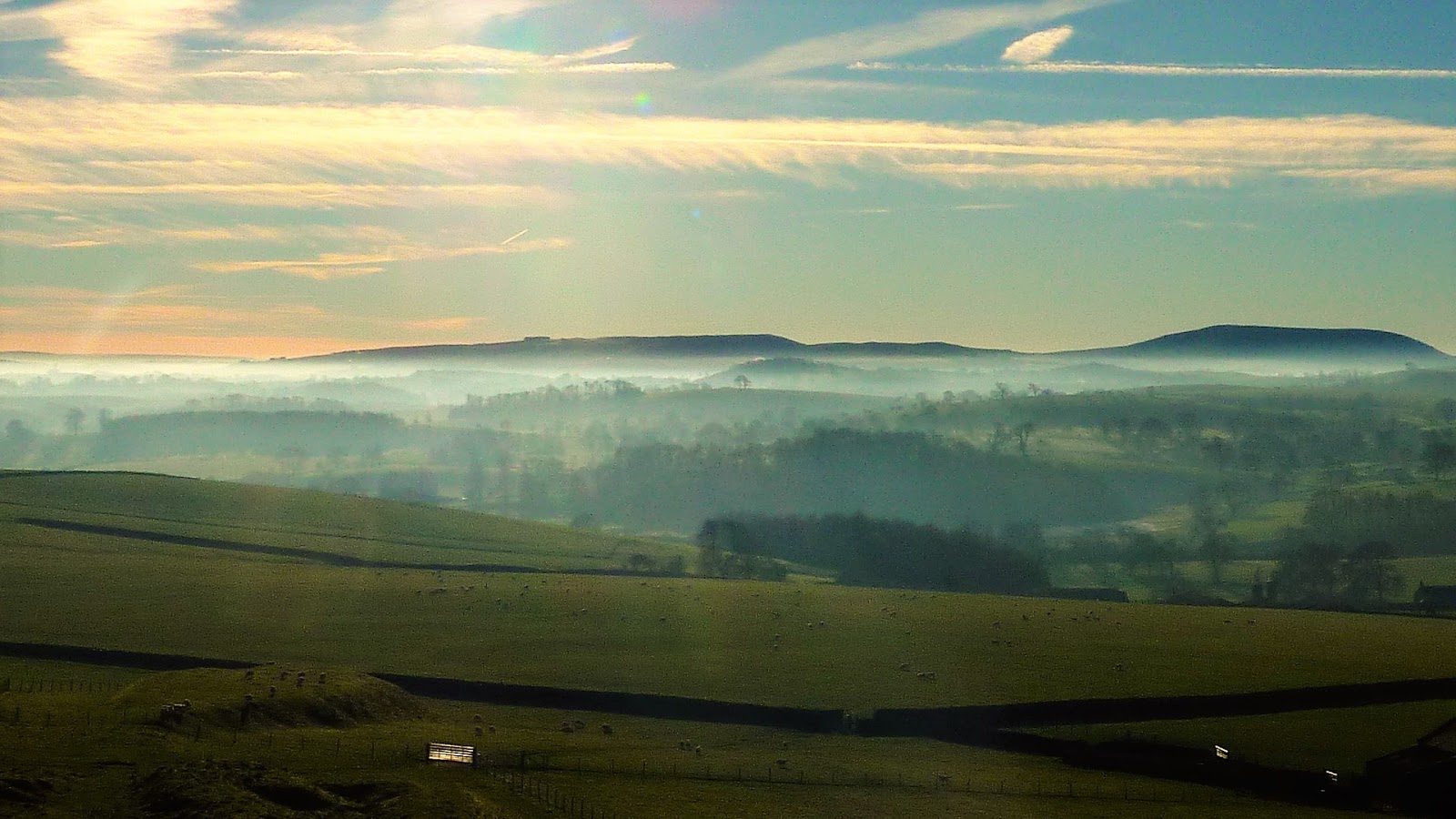
Pendle - in mist and sunshine

Enjoyed a great walk on Saturday. Starting from Gargrave, headed on to Bell Busk via Coniston Cold. Stopping for a quick sandwich on Haw Crag. All the way round, heavy mist laid in the valleys and low lying land but from the top of the Crag, Pendle Hill's summit appeared suspended between the mist and clear blue sky. A bewitching sight of such a famous hill.

Thursday, November 10, 2016

Now let us praise the President-Elect...

As politicians - mainly on the right (or very-far-right) - line up to congratulate JD Trump, here's a reminder from Auden where adulation for the abhorrent ends.
WH Auden Epitaph on a Tyrant
Perfection, of a kind, was what he was after, And the poetry he invented was easy to understand; He knew human folly like the back of his hand, And was greatly interested in armies and fleets; When he laughed, respectable senators burst with laughter, And when he cried the little children died in the streets.
The prophetic voice from January 1939.

Thursday, November 03, 2016

Royal Prerogative is a funny way of delivering democracy, isn't it Mrs May?

Welcome news that the government can't trigger Art 50 behind closed doors by claiming to use the pre-civil war powers of the sovereign. Back at my law school, we learned about the power of the courts in preventing the widening of prerogative powers, in the telling phrase of Lord Diplock in BBC v Johns that it is
350 years and a civil war too late for the Queen’s courts to broaden the royal prerogative
. A short, sharp reminder of the limits of the profoundly undemocratic power that the executive craves, but which judges can reign in as a defence against the untrammelled exercise of political power. The deluded Brexiters who rejoice that we've 'taken back' the country, now need to learn another lesson - that Parliament is the supreme law-maker and has the right to control the work of government ministers, particularly when they think it better to do shabby deals in closed rooms that will have a profound effect on our lives and the economy for years to come. An appeal would be most unwise...

Tuesday, November 01, 2016

55 - an age of wondrous new invitations...

Reaching 55 has led to an array of interesting offers and invitations: from hearing aid tests to pension drawdowns (Mr Osborne's special gift to the middle-aged); not to mention Michael Parkinson and his free pen and 'no questions' life insurance policy. But of far more pressing need today is the invitation to attend my local NHS hospital for bowel scope screening. Now, don't get me wrong, colo-rectal cancer is a serious disease that affects a higher proportion of those 55 and older, but one particular aspect of it, as announced in the invitation, caused me to have a brief smile at a long-ago Viz cartoon strip. The invitation, loving crafted on a standard NHS letterheading, came with a leaflet that explained the procedure before going on to tell me that I could watch the procedure on a monitor, if I so desired. And this is where Roger Mellie raised his head. In the late 80s cartoon, he was pitching an idea for a new TV programme - one that now seems oddly prescient. It was called Up the Celebrity Arsehole. Although he's since reprised the concept for the X-Factor judges, in the original, Mellie's idea is at first rejected as his producer tells him no celebrity would agree to be placed behind a curtain and given a stage-based colonoscopy that members of the public are then shown and the winner is the first to guess the celeb's identity. Mellie persists, however, and the final frame shows a man crouched on a table while Mellie urges 'Mr Slattery' to bend over further so they can get the camera in (reference to the ubiquitous TV personality Tony Slattery, although now TOWIE would probably provide a whole host of far keener 'celebs' willing to bend and pose. So, this afternoon, I'm going to struggle to keep a straight face when asked if I want to see my 'performance' on screen: the revolution might not be televised, but the endoscopy very well might be - over to you Roger.