Wednesday, January 11, 2017
A Teddy Moment
I was an Andy Pandy fan when I was a pre-schooler and one scene in particular sent me into fits of toddler giggles.
Andy's companion Teddy (he's a bear, for the uninitiated) had a habit of standing in the middle of the set with his paws over his eyes. The ursine logic was wrong, but compelling (and funny - to me, at any rate. Teddy believed that he couldn't be seen by anyone because he couldn't see anything, even though he was 'standing in plain sight'.
A simple device that caused me much childish mirth, but now our politicians seem to have fallen prey to the Teddy 'paws over eyes' syndrome - linguistically at least - by adopting the mantra 'I don't recognise' so-and-so to avoid having to answer questions based on facts that contradict their point of view.
It was funny when Teddy did it way back then, it's pathetic now and devalues democracy.


Thursday, January 05, 2017
Superior retail confectioner
I was put rather firmly in my place recently while buying a couple of cinnamon buns at a well-known mass outlet bakery operation that begins with a G. On entering, I noticed cinnamon buns placed in the display incorrectly identified on the card as Belgian buns.
In a moment of madness, as I now realise, the words 'two Belgian buns, please' tripped off my tongue, to which the shop assistant replied 'we haven't got any today'. Undeterred, I walked to the cinnamon/Belgian buns and pointed, at the same time asking for 'two of those'.
Sensing the need to educate, the assistant looked quizzically at me and then enunciated slowly and deliberately 'those are cinnamon buns' - with added emphasis on the last two words.
Suitably chastened, I paid and left the shop with the cinnamon buns in a paper bag. But then I remembered a similar incident many years ago in a Birmingham confectioners. I was attracted to a rectangular cake with cherries and a dusting of icing sugar, my request for 'one of those, please' was met with the decidedly superior reply 'that, is a paradise slice'.
Are confectioners trained in the overarching need to teach customers the correct name for each and every one of their products?
Tuesday, December 20, 2016
East West Street: On the Origins of Genocide and Crimes Against Humanity by Philippe Sands
This is a great book and a worthy winner of the 2016 Baillie Gifford non-fiction prize, in which Philippe Sands traces the development of the international law terms ‘crimes against humanity’ and ‘genocide’.
But this is no dry legal treatise, largely due to his extensive research and highly engaging writing style, Philippe Sands shows how the lives of Hersch Lauterpacht, Rafael Lemkin and his maternal grandfather Leon Buchholz came to be intertwined in the now Ukrainian city of Lviv.
While Lauterpacht and Lemkin studied there – with Lauterpacht going on to an academic career in Law at Cambridge, where he developed the concept of ‘crimes against humanity’ in an attempt to protect the rights of individuals, Lemkin’s work was focused on the protection afforded to identifiable groups and races by calling for recognition of the crime of genocide. On the other hand, Leon Buchholz lived through the full horror of the Nazi invasion before escaping to Paris, where he was eventually joined by his infant daughter and later his wife.
The crimes defined by Lauterpacht and Lemkin featured in the indictments used at the Nuremberg trials, where Lauterpacht’s ‘crimes against humanity’ gained wider support than Lemkin’s ‘genocide’. Although arguable that this has been reversed in the prosecution of post-WWII war crimes, Sands’ narrative has an edge-of-the-seat quality as legal argument and the preferring of charges show how the four prosecution authorities built their cases against the defendants.
Hersch Lauterpacht looms large in the development of international law, but at Nuremberg his powerful intellect and professionalism are brought face-to-face with the accused – at a time when he did not yet know the fate of so many of his own family members. The last five years of his life were spent as the British judge to the International Court of Justice in the Hague; an appointment that was criticised by some in politics and the media on the dubious – and frankly worrying ground – that he was not ‘sufficiently British’.
Sands’ work is a triumph of research and great writing, as a work of legal history it also stands as a salutary warning for today, perhaps best encapsulated in George Santayana’s telling observation that: ‘Those who fail to learn from history are doomed to repeat it’.
East West Street: On the Origins of Genocide and Crimes Against Humanity, published by Weidenfeld & Nicolson, ISBN 9780385350716 (print) ISBN 9780385350723 (e-book)
Monday, December 05, 2016
Royal prerogative - a lesson from the swinging 60s
Back in 1964 the BBC ended up in the Court of Appeal over a spat with the Inland Revenue, in which Auntie decided that it qualified to be treated in pretty much the same way as the rest of the establishment by using the Royal Prerogative (RP) to trump a tax claim.
Now, the RP has a bit of a chequered history, mainly due to the activities of one Charles Stewart, or Charles I if you prefer (the only monarch to end their reign approx 10 inches shorter than at the start).
The Beebs legal argument came to naught, largely thanks to the memorably pithy putdown from Lord Diplock, who said: it was "350 years and a civil war too late" to allow for a broadening of the RP.
Strangely enough, the Daily Heil didn't come out against the noble Lord as an "enemy of the people" on that occasion (probably because he was putting the Beeb in its place?). But today we're faced with Paul Dacre and his band of scribblers busily casting themselves as the enemies of the Rule of Law, which is a far more dangerous place to be - and one that not even Art.10 of the European Convention on Human Rights (Oh, irony of ironies: how wonderful if he ends up having to hide behind that to defend himself!) will stretch far enough to cover his twisting of fact and inflated, yet baseless, opinions.
Thursday, December 01, 2016
Christmas is coming, the Bishop's talking out of his hat
A few years ago, I remember a vicar got into a spot of bother by revealing that Santa couldn't exist on the basis that no-one could travel fast enough to deliver all those presents in one night. Struck me at the time as a pretty lame way of getting some media exposure, but, sure enough, he got a panning from those who thought he was being a kill-joy.
Now, Nick Baines - fast becoming the go-to bish for a press quote or three - has given an interview criticising 'intolerant liberalism': a phenomena he's come up with to explain why some Christians are 'afraid' to talk about their faith. I am a Christian and not afraid of talking. Any fear comes from being identified with dogmatic evangelicals and intolerant head-bangers who won't engage with anything outside of their very narrow views.
While I agree that you can't - and shouldn't - take religion out of Christmas, one reason many don't want to talk about Christianity is the failure of Church leaders to address matters of faith in a way that people understand - trendy preachiness is far more harmful than intolerant liberals.
Monday, November 28, 2016
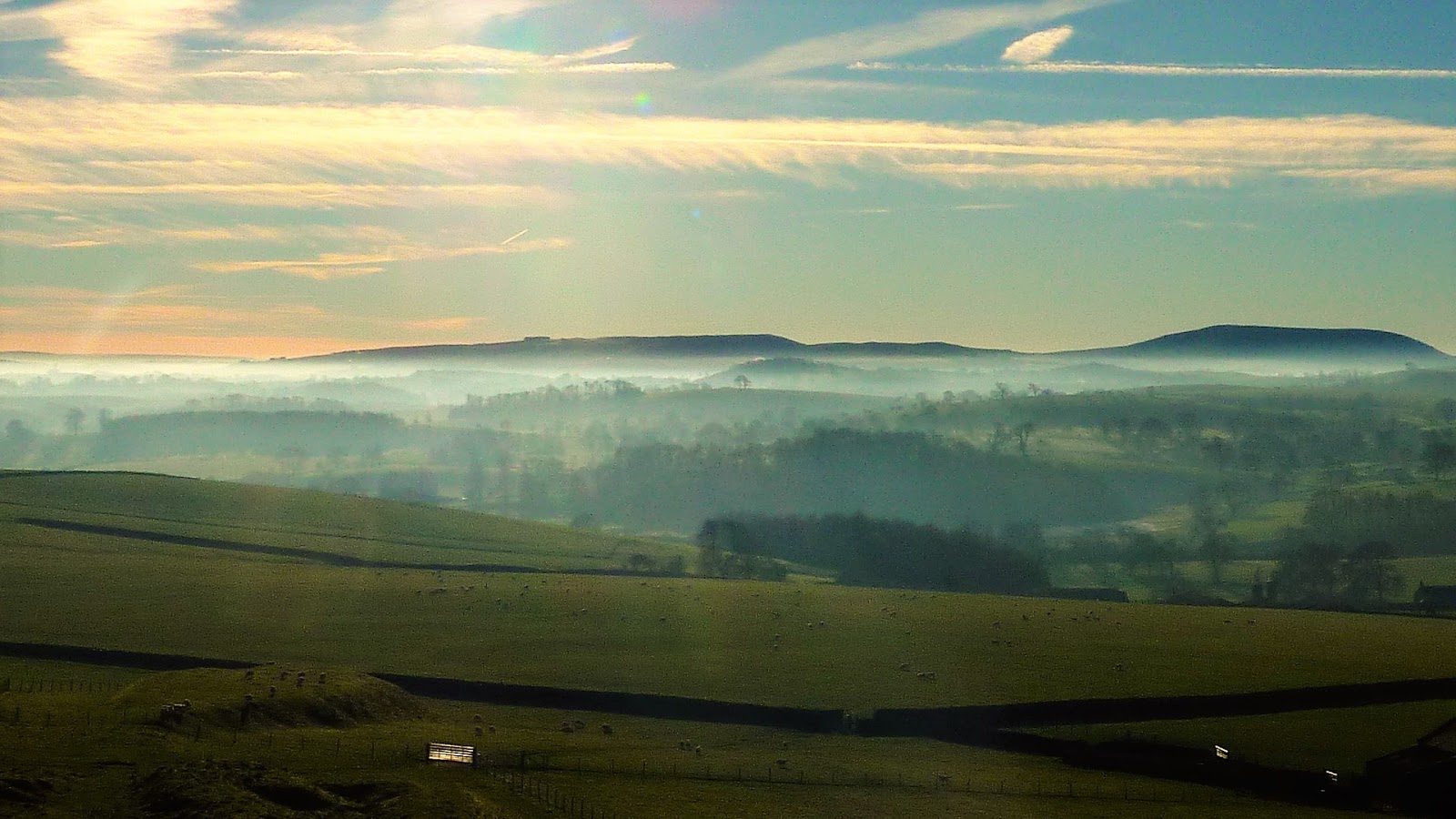
Pendle - in mist and sunshine
Enjoyed a great walk on Saturday. Starting from Gargrave, headed on to Bell Busk via Coniston Cold. Stopping for a quick sandwich on Haw Crag. All the way round, heavy mist laid in the valleys and low lying land but from the top of the Crag, Pendle Hill's summit appeared suspended between the mist and clear blue sky. A bewitching sight of such a famous hill.
Thursday, November 10, 2016
Now let us praise the President-Elect...
As politicians - mainly on the right (or very-far-right) - line up to congratulate JD Trump, here's a reminder from Auden where adulation for the abhorrent ends.
WH Auden Epitaph on a Tyrant
Perfection, of a kind, was what he was after, And the poetry he invented was easy to understand; He knew human folly like the back of his hand, And was greatly interested in armies and fleets; When he laughed, respectable senators burst with laughter, And when he cried the little children died in the streets.The prophetic voice from January 1939.
Thursday, November 03, 2016
Royal Prerogative is a funny way of delivering democracy, isn't it Mrs May?
Welcome news that the government can't trigger Art 50 behind closed doors by claiming to use the pre-civil war powers of the sovereign. Back at my law school, we learned about the power of the courts in preventing the widening of prerogative powers, in the telling phrase of Lord Diplock in BBC v Johns that it is
350 years and a civil war too late for the Queen’s courts to broaden the royal prerogative. A short, sharp reminder of the limits of the profoundly undemocratic power that the executive craves, but which judges can reign in as a defence against the untrammelled exercise of political power. The deluded Brexiters who rejoice that we've 'taken back' the country, now need to learn another lesson - that Parliament is the supreme law-maker and has the right to control the work of government ministers, particularly when they think it better to do shabby deals in closed rooms that will have a profound effect on our lives and the economy for years to come. An appeal would be most unwise...
Tuesday, November 01, 2016
55 - an age of wondrous new invitations...
Reaching 55 has led to an array of interesting offers and invitations: from hearing aid tests to pension drawdowns (Mr Osborne's special gift to the middle-aged); not to mention Michael Parkinson and his free pen and 'no questions' life insurance policy. But of far more pressing need today is the invitation to attend my local NHS hospital for bowel scope screening.
Now, don't get me wrong, colo-rectal cancer is a serious disease that affects a higher proportion of those 55 and older, but one particular aspect of it, as announced in the invitation, caused me to have a brief smile at a long-ago Viz cartoon strip.
The invitation, loving crafted on a standard NHS letterheading, came with a leaflet that explained the procedure before going on to tell me that I could watch the procedure on a monitor, if I so desired. And this is where Roger Mellie raised his head. In the late 80s cartoon, he was pitching an idea for a new TV programme - one that now seems oddly prescient. It was called Up the Celebrity Arsehole. Although he's since reprised the concept for the X-Factor judges, in the original, Mellie's idea is at first rejected as his producer tells him no celebrity would agree to be placed behind a curtain and given a stage-based colonoscopy that members of the public are then shown and the winner is the first to guess the celeb's identity. Mellie persists, however, and the final frame shows a man crouched on a table while Mellie urges 'Mr Slattery' to bend over further so they can get the camera in (reference to the ubiquitous TV personality Tony Slattery, although now TOWIE would probably provide a whole host of far keener 'celebs' willing to bend and pose.
So, this afternoon, I'm going to struggle to keep a straight face when asked if I want to see my 'performance' on screen: the revolution might not be televised, but the endoscopy very well might be - over to you Roger.
Saturday, October 29, 2016
Tricky treats
Visited my local Specsavers branch this morning to collect my new specs. I was served by a dispensing optician dressed as a witch while her boss was swanning around in full Dracula-mode. Why has the daftness of trick or treat now started to infect the grown-ups at work?
Thursday, October 27, 2016
Time in the Lakes
Got back last night from a couple of days in the Lakes. We stayed in Windermere, which I never used to like very much, mainly because of the traffic, but the hotel was clean and bright, with friendly staff.
Managed a couple of walks; on the first day the Coffin trail from Ambleside to Grasmere (where we had the obligatory afternoon tea - or coffee in my case). Then yesterday, we took an Ullswater Steamer from Pooley Bridge to Howtown and walked back on the low level, mainly lake shore path.


 From Pooley Bridge we went over to Penrith, not a town we'd visited before. A new shopping complex, the New Squares, was largely devoid of life, but home to a fair number of estate agents' signs. For a town with a fair few rather imposing squares already, the new addition seemed rather bland - cream walls in place of the traditional stone; still, with a large Sainsbury as the obvious 'anchor tenant' the local worthies obviously expect great things of the development.
After the events of the past few weeks, the break was much needed and allowed me to recharge my batteries, and I also received an email from a prospective new client, which perked me up still further. Still, it's a shame so much has been 'monetised' - 20p for a slash, with railway-style entry barriers standing sentinel at the entry to all public loos, and parking at £8.00 for anything over 4 hours, means spending time in the Lakes equates with spending a lot of money doing things that used to be free.
From Pooley Bridge we went over to Penrith, not a town we'd visited before. A new shopping complex, the New Squares, was largely devoid of life, but home to a fair number of estate agents' signs. For a town with a fair few rather imposing squares already, the new addition seemed rather bland - cream walls in place of the traditional stone; still, with a large Sainsbury as the obvious 'anchor tenant' the local worthies obviously expect great things of the development.
After the events of the past few weeks, the break was much needed and allowed me to recharge my batteries, and I also received an email from a prospective new client, which perked me up still further. Still, it's a shame so much has been 'monetised' - 20p for a slash, with railway-style entry barriers standing sentinel at the entry to all public loos, and parking at £8.00 for anything over 4 hours, means spending time in the Lakes equates with spending a lot of money doing things that used to be free.


 From Pooley Bridge we went over to Penrith, not a town we'd visited before. A new shopping complex, the New Squares, was largely devoid of life, but home to a fair number of estate agents' signs. For a town with a fair few rather imposing squares already, the new addition seemed rather bland - cream walls in place of the traditional stone; still, with a large Sainsbury as the obvious 'anchor tenant' the local worthies obviously expect great things of the development.
After the events of the past few weeks, the break was much needed and allowed me to recharge my batteries, and I also received an email from a prospective new client, which perked me up still further. Still, it's a shame so much has been 'monetised' - 20p for a slash, with railway-style entry barriers standing sentinel at the entry to all public loos, and parking at £8.00 for anything over 4 hours, means spending time in the Lakes equates with spending a lot of money doing things that used to be free.
From Pooley Bridge we went over to Penrith, not a town we'd visited before. A new shopping complex, the New Squares, was largely devoid of life, but home to a fair number of estate agents' signs. For a town with a fair few rather imposing squares already, the new addition seemed rather bland - cream walls in place of the traditional stone; still, with a large Sainsbury as the obvious 'anchor tenant' the local worthies obviously expect great things of the development.
After the events of the past few weeks, the break was much needed and allowed me to recharge my batteries, and I also received an email from a prospective new client, which perked me up still further. Still, it's a shame so much has been 'monetised' - 20p for a slash, with railway-style entry barriers standing sentinel at the entry to all public loos, and parking at £8.00 for anything over 4 hours, means spending time in the Lakes equates with spending a lot of money doing things that used to be free.
Tuesday, September 27, 2016
Typesetting - a dying art?
When I started work in the printing industry in 1977, type was still set using the 'hot metal' process, and the job of compositor was key to the way words appeared on the page - in much the same way as they had for the previous 400-years.
Within a few years, however, type was set onto film or photographic paper (called 'photo-setting'). This proved to be short-lived, due to the arrival of computers and typesetting software, which allowed text to be made ready for printing in a fraction of the time taken by even the most skilled compositor.
Domination of the art by computer-based typesetting also met a swift decline with the advent of SGML, XML and HTML mark-up languages. The advantage here being that text 'captured' within the tags used for each of these processes can be used in print or online without having to be re-typed.
But, and it's a big 'but', there is still a role for the hard-pressed typesetting compositor of yore. XML capture requires words in bulk, but some texts are destined for print that do not warrant the creation or in-depth application of XML etc tagging. There is, thankfully, work for the typesetter yet. Wonder how many apprentices are being trained in this essential work?
Friday, September 02, 2016
A private walk through public school grounds
Those dog-days of August can weigh heavy some years. So it was, with a new academic year soon to start, I decided to play pre-term truant for a day this week and go for a walk around the Cumbrian town of Sedbergh. I'd vaguely heard of a public school of the same name, but didn't know - until I arrived there - that the school pretty much is the town.  It has been there since its foundation in 1525, so I suppose it has earned the right to flex its muscles a bit. After all, if the locals can't afford to send their own kids there (and at £10,500 a year for boarders - after paying the £750.00 registration fee, buying the uniform and sundry other expenses - such as Combined Cadet Force annual camp fee - of which more later), a fair few earn their living from the place.
The school is so intertwined with the town that the signposts mingle as well: one minute you're looking at a sign for the Tourist Information Centre and the parish church, the next you're being directed to the Bursary and Headteacher's Office. There is also a fair degree of latitude when it comes to public footpaths, and I wandered along the edge of playing fields as the current crop of ruby-playing Sedberghians were learning how to beat next term's opponents into a bloody pulp, and along the banks of the rivers Dee and Rawthey that mark the furthest extent of the school grounds.
The ethos of the place proved to fascinating. Founded before the Reformation by Roger Lupton, a local man who became Provost of Eton and endowed the school with scholarships to St John's College, Cambridge University, the school boasts strong links to the Church of England, with a chapel that is larger than many English parish churches. The prospectus throws up a few anomalies here, however. While all pupils have to attend chapel, and are encouraged to both sing hymns in a way that's 'strong and heartfelt' and allow themselves to be prepared for confirmation into the Anglican Church, they are also expected to sign up wholesale to either the Navy, Army or Air Force sections of the Combined Cadet Force as soon as they start Year 9 (13-14). In addition, those who play percussion or wind instruments are automatically enrolled into the school's Corps of Drums. Exception from this Eton Rifles form of junior conscription is at the Head's discretion and must be sought in writing by parents. All have to attend annual military camp - the bill being added to the last invoice sent to parents/guardians for the current school year.
All in all, this struck me as a rather 1950s anachronistic playing out of the old cries of 'Praise the Lord and Pass the Ammunition' or 'We come in peace, shoot to kill'.
A more peaceful alternative so such 'robust' (or even rather confused Christian theology) can be found nearby:
It has been there since its foundation in 1525, so I suppose it has earned the right to flex its muscles a bit. After all, if the locals can't afford to send their own kids there (and at £10,500 a year for boarders - after paying the £750.00 registration fee, buying the uniform and sundry other expenses - such as Combined Cadet Force annual camp fee - of which more later), a fair few earn their living from the place.
The school is so intertwined with the town that the signposts mingle as well: one minute you're looking at a sign for the Tourist Information Centre and the parish church, the next you're being directed to the Bursary and Headteacher's Office. There is also a fair degree of latitude when it comes to public footpaths, and I wandered along the edge of playing fields as the current crop of ruby-playing Sedberghians were learning how to beat next term's opponents into a bloody pulp, and along the banks of the rivers Dee and Rawthey that mark the furthest extent of the school grounds.
The ethos of the place proved to fascinating. Founded before the Reformation by Roger Lupton, a local man who became Provost of Eton and endowed the school with scholarships to St John's College, Cambridge University, the school boasts strong links to the Church of England, with a chapel that is larger than many English parish churches. The prospectus throws up a few anomalies here, however. While all pupils have to attend chapel, and are encouraged to both sing hymns in a way that's 'strong and heartfelt' and allow themselves to be prepared for confirmation into the Anglican Church, they are also expected to sign up wholesale to either the Navy, Army or Air Force sections of the Combined Cadet Force as soon as they start Year 9 (13-14). In addition, those who play percussion or wind instruments are automatically enrolled into the school's Corps of Drums. Exception from this Eton Rifles form of junior conscription is at the Head's discretion and must be sought in writing by parents. All have to attend annual military camp - the bill being added to the last invoice sent to parents/guardians for the current school year.
All in all, this struck me as a rather 1950s anachronistic playing out of the old cries of 'Praise the Lord and Pass the Ammunition' or 'We come in peace, shoot to kill'.
A more peaceful alternative so such 'robust' (or even rather confused Christian theology) can be found nearby:  the hamlet of Briggflats is home to England's third oldest Quaker Meeting House, where peace is very firmly on the agenda, and lusty hymn singing most certainly not - the silence reigns supreme.


Wednesday, August 31, 2016
Four Yorkshiremen? One's enough if you're Three Peaking
Called into the Coop garage and store in Ingleton this morning for some diesel on my way to Sedbergh for a day's walking. The man behind the counter was giving a masterclass in pure Yorkshire tyke upmanship, regaling a young couple with tales of his Three Peaks exploits.
Not only had he climbed Whernside, Ingleborough and Pen-y-ghent just last weekend, breaking off to bring a friend back who'd come down with sunstroke, but he was planning to do the route back-to-back, a double three peaker, towards the end of September.
The couple left, expressing their amazement at his prowess, while I was left pondering how - if the other three had turned up - they'd have told how they completed the whole thing half an hour before they'd set off...
Sunday, August 28, 2016
A cardiac non-event, thankfully
Quiet weekend? Mine was, until about 3.15 on Saturday afternoon when the chest pain started. Nothing to worry about, I thought at first. Then it spread to my back and up towards the right side of my jaw.
That's when we phoned 111. And after a very short conversation with the call handler, he said the words 'the ambulance is on its way'.
Enter the freelance paramedics
The arrival of male and female, green-clad, machine-bearing wonderbeings made me start to feel better (Brexiters look away now: one was Irish, the other had an indeterminate Spanish/Italian accent - both were utterly incredible). Getting rigged up to the ECG machine took minutes, and the print-out was clear, so I was assured. This first bit of good news was followed by blood pressure check and a once over with a stethoscope.
I was then presented with a choice; go to hospital for a blood check to search out an enzyme that usually lives in the heart but tends to leach out if you've had a heart attack (cardiac event, in medical-speak - which I was rapidly becoming fluent in) or stay at home and avoid the late afternoon queue in A&E. No brainer, I thought; then I was put on to the paramedics' controller, who very efficiently scared the 'bejeezus' out of me, according to the Irish paramedic (not being stereotypical: that's really what she said!).
In the ambulance, I learned that my paramedics were self-employed contractors working for Falck, a rather strange concept and one that - although grateful for at the time - does make me wonder, yet again, about the extent of privatisation in the NHS.
A&E bound
So, were away to A&E with my wife following on behind. At A&E, the service was so swift I'd had blood taken and been chest x-rayed before my wife had parked the car and found the cubicle. The chest x-ray was delivered to the supervising medics virtually instantaneously, but the blood test result took a little over two hours. But an all-clear, accompanied by the instruction to see my GP as soon as possible after the holiday weekend was worth the wait.
Tuesday, August 23, 2016
Playing doctors at the chemist
'Could I have some of those one-a-night sleep tablets, please?'
'You mean the sleep aid?' replied the assistant in the Tesco Pharmacy. I agreed that was the product I wanted, only to be then asked when I'd last taken them.
Having said it was a few months ago - the annoying fact of insomnia strikes from time-to-time. The assistant scanned the pack and then finished by reminding me 'not to take them before driving'. 'No', I replied: 'I tend not to do that when I'm getting into bed' - like it says on the front of the pack.
Return to the stone age
The new neighbours are having some work done. Not sure what the end result is intended to be, but it seems to involve a lot of stone cutting. They've engaged a firm of stonemasons, who seem to favour full throttle petrol-driven cutters and shouted instructions/banter.
It was never like this with Fred and Barney. Yabba, dabbo, don't...
Friday, August 19, 2016
UK Passports - a beta work in progress
Remember Farage getting rather over-excited about the return of the dark blue UK passport during the referendum campaign?
Strange to relate, but the UK government's application site is now a beta test version, which could suggest that Nige's dream could be about to be turned into internet reality. It that's so, it's to be hoped the pointy heads sort out the print function, as it just made my printer churn out 30-odd pages of unprinted, still pristine white paper, as opposed to the promised declaration form.
All in all, the experience left me feeling that, once again, Brexit is going to be a lot harder to deliver in reality (whatever form that might eventually take) than the over-hyped, truth-free version promised to use by the Leavers during the campaign.
Monday, August 15, 2016
I'm a nursing algorithm
Strange things can happen when you register with online work/employment agencies, particularly those whose web presence is driven by poorly constructed algorithms.
For example, having registered for editorial work with CareerBuilder.co.uk I've been sent a rash of NHS/nursing vacancies (and unsubscribing doesn't seem to stop them).
Now, while I can very quickly and painlessly remove an unneccessary apostrophe you probably wouldn't want me to try the same trick with your ingrowing toenail or bunion. Not that the algorithm seems to mind...
Monday, August 01, 2016
Marsh Barton
First drove through Exeter 30-odd years ago and got lost at Marsh Barton due to poor road signing. Today, in pouring rain, got stuck at MB again. Exeter has park and ride now, but nearest location to where we're staying turned out to be the dreaded Marsh Barton and it was full when we arrived. Extricating the car from there took nearly half an hour of bumper to bumper queuing.
Great city - shame about the roads.
Subscribe to:
Posts (Atom)