Sunday, August 20, 2017
PAC: blink and you miss it
You find a better mobile deal with another provider but how can you keep your number? Answer - request a Porting Authorisation Code (PAC) from your current provider - should be simple enough, except that it isn't
The current provider doesn't want to lose your custom, so they make it really hard. First thing, build in a bit of a delay - it can take 24 hours for them to notify you of the PAC and then you have to give it to the new kids on the block within 30 days, otherwise it expires and the whole giddy performance starts again. A second complication is that the current provider might suddenly decide to make things difficult: a PAC can only be given over the phone, not by email or text. Why the hell not - they're supposed to be in the communication game, except no-one seems to have told the PAC creation fairies. Or rather they have, along with the instruction to make it all as ball-achingly difficult as possible.
After 4 days of waiting for 3 to get their PAC ducks in row, patience has now worn so thin that a call to Ofcom is seriously on the cards. That is unless they really do phone back within the next hour, which I certainly don't believe or an instant is about to happen.


Thursday, July 27, 2017
Leeds misleads
The BBC headline was intriguing at first glance. Leeds, the old home town (OK, city) 'may' be about to 'get' a New York-style 'high line'. Wow, I thought. One in the eye for the Big Apple. But wait, it turns out Leeds has had it since Victorian times and the last time people could walk on it was 1988.
If it's already there - all 92 viaduct arches of it - how come we're just about to 'get' it?
A more accurate headline would have read 'Leeds remembers it's got a High Line that's every bit as impressive as those in New York and Paris'. But then, the city is rather good at forgetting things - like the flax mill built to copy an Egyption Temple, Colonel Harding's campanile tower, the forlorn Queen Victoria's Arch, abandoned to fate and the elements in Beckett's Park, and the Headingley Bear Pit.
Wednesday, July 26, 2017
Just a tiny bit call centre
I'm looking for some extra work at the moment and was offered a 'phone interview for a job with one of the major outsourcing companies (no names, you'll see why...)
The advert was non-specific on a number of key areas: I knew what service was being provided, but for whom and how were well hidden behind generic - and in several places ungrammatical - waffle.
A few minutes in, the HR bod mentioned that the job could involve handling a number of telephone calls, to which I asked 'is this a call centre?' A pretty straightforward question in the circumstances, one would have thought. To which the answer ran along the lines of 'no, um, rather yes'.
It either is or it isn't - you can't be a 'little bit' call centre any more than you can be a little bit pregnant.
There comes a point when relativism has to meet certain boundaries and I felt less than comfortable that an prospective employer could want to hide the real nature of a job by advertising in such broad terms.
Thursday, July 20, 2017
Is there a competent elephant in the room?
It might come as a surprise, but there are some who work in the private sector who might be tempted to apply for a public sector post on the basis that it meets their skill set.
Private sector job descriptions can be very long-winded and appear more as a wishlist for a superhuman form of employee possessing skills and experience that runs for page after page. For the intending applicant, these are daunting at first reading, but if you can group them into workable categories that can be addressed in the application, then a perceptive recruiter (even if not possessed of sufficient editorial skill to prune the verbage in the first place) can evaluate a ‘broad-brush’ application.
In the public sector, however, the tendency now if for highly specific internal skills that appear almost impenetrable to the private sector (or, even worse, self-employed/freelance applicant). This is strange, given that many public sector employers trumpet ‘diversity’ and ‘equality’ as being key to their recruitment processes. The paradox is further complicated by the universal – if nonsensical – way that both public and private sectors have embraced competency-based interviews as the only game in town.
Faced with the usual six competency questions (three broad, three job specific) the danger for the private sector ‘outsider’ who has made it to interview is that you are hard pressed to identify the key words and phrases that are often meat and drink to public sector ‘insider’ applicants. Short of a Rosetta Stone or the divining powers of a dowser, private sector or freelance applicants are immediately at a serious disadvantage and can go on to award themselves the bum’s rush before they even realise that something’s amiss in their responses.
A nice touchy feely ‘We welcome applicants irrespective of age gender, orientation, ethnicity, religion’ is all very well, but diversity can go take a running jump if you then rule the applicant out by a too narrow or overly subjective application of the competency criteria.
Wednesday, July 19, 2017
Looking for Leeds Central
The first verse of Hue & Cry’s song Looking for Linda contains an intriguing railway mystery. Linda, the eponymous heroine/victim of the song is escaping from an abusive relationship when she meets the singer, a wandering railway troubadour presumably, on a slow train, heading – she hopes – for Paisley.
So far, so ScotRail, but things then take a strange turn, as Linda keeps on running away ‘straight down to Leeds Central’. Now, assuming the slow train connected at Paisley to a train, or trains, that could take Linda to Leeds, the choice of the Central suggests time travel, because that station closed in May 1967, twenty-one years before the song was released.
Leeds only has one main station now, the rather unimaginatively named Leeds City. It is the third busiest station outside London in the UK, behind Glasgow Central and Birmingham New Street, which rather suggests closing the Central wasn’t perhaps the smartest of Beeching’s moves, especially if you’ve ever had to wait on a stationary train until a platform comes free.
Pat and Greg Kane’s choice of Central over City for Linda’s arrival into Leeds could be down to the way the words scan – arguably the former fits better than the shorter four-letter alternative, and avoids repetition of the word ‘city’ within the space of two words. As with many artistic choices, this creates an image in my mind of something I’m not even sure actually happened but represents a very important first meeting between my much younger self and great aunt Vera, my grandma’s sister.
Vera lived in Dublin and her visits to Leeds were eagerly anticipated joyful occasions. In later years, she flew in to the then Yeadon Airport (now Leeds/Bradford), but her first visit of my lifetime was a sea crossing, from either Dun Laoghaire or North Wall to Holyhead, with a boat train bringing her the rest of the way. As Leeds Central closed when I was five, what follows could be mere wishful thinking on my part, but – like the song – actual reality isn’t as important as the impression. Great aunt Vera had to get off the train from Holyhead somewhere, and Leeds Central seems to be as good a place as any for me.
In my memory, my parents, grandparents and I, are standing on a long platform with buffers in front and some trains, steam trains, close up to the buffers. Down a long side platform, running the length of a train, my great aunt is walking towards us, a great beaming smile on her face and the light playing on her pale ginger hair.
Stations are evocative places; memories of arrivals and departures, families, friends, lovers reunited or divided. And Leeds Central would have been no different; it was a terminal station, so trains arriving here were going no further, this was the end of the line, and in 1967 those lines ended permanently.
The ground was cleared of all trace of the railway, with the exception of two stone-built goods lifts, that had been used to transfer mail and other freight from road level to the platforms above. For many years they stood marooned amid a scene of urban devastation. Eventually, the site became the Aireside Shopping Centre, which suffered from a chronic lack of parking. Too close to the city centre to be ‘out of town’, you took pot luck finding a place to park either in front of the shops or dodging traffic wardens on the surrounding streets.
Now the shoppers have gone, replaced by the Wellington Place Development, which means commerce and law have now moved onto the site. One of the three-storey goods lifts remains – a reminder of the station and all those who it brought into and out of the city.
One last thought on Looking for Linda lyrics: £35 for a packet of fags was a hell of a lot in the 1980s - what was she smoking, gold-filter tipped Balkan Sobranies?
Friday, May 05, 2017
Push, don't pull
A 'comfort stop' ahead of a crucial meeting caused a moment's unwanted panic-induced hilarity.
Picture a designer gents in a swish office block. Floor to ceiling cubicle doors with polished steel handles and door locks.
Entry was successfully effected, but on trying to leave the door refused to open. Fearing a broken lock, I slowly turned the lock while trying the handle, all to no avail.
Taking a moment to reflect - and also envisage calling for help and being rescued by security - I returned to the door, only to find that it opened outwards, so my frantic pulling was no use whatsoever.
A small push sign would be a welcome design addition...
Saturday, April 01, 2017
The barbarians are within the gates
These photographs show the sadly now closed Burley Library on Cardigan Road in Leeds.
 Strangely enough, the disused building sits cheek by jowl with some very swanky new student accommodation and is situated within an area that has been term-time home to students from Leeds and Leeds Beckett Universities for years.
Admittedly it's some time ago now, but when I was a student we spent rather a lot of our time in libraries. Looks like things have moved on now, though.
After all, Leeds has always liked to think its at the cutting edge of social change. I can remember when it proudly proclaimed itself 'Motorway City of the 70s' - and if you want to see how well that turned out, try circumnavigating the Inner Ring Road around 9.00am or 5.30pm.
Perhaps the city worthies should have kept the libraries and found enough money for a tram system. You know, like they have in Manchester, Sheffield and Nottingham.
Strangely enough, the disused building sits cheek by jowl with some very swanky new student accommodation and is situated within an area that has been term-time home to students from Leeds and Leeds Beckett Universities for years.
Admittedly it's some time ago now, but when I was a student we spent rather a lot of our time in libraries. Looks like things have moved on now, though.
After all, Leeds has always liked to think its at the cutting edge of social change. I can remember when it proudly proclaimed itself 'Motorway City of the 70s' - and if you want to see how well that turned out, try circumnavigating the Inner Ring Road around 9.00am or 5.30pm.
Perhaps the city worthies should have kept the libraries and found enough money for a tram system. You know, like they have in Manchester, Sheffield and Nottingham.


Sunday, March 12, 2017
Spiced up customer service - Curry's of a Sunday afternoon
Just back from a trip to Curry's. We were hoping to buy an small freezer, to live under a worktop, and a hotplate. The first item had been moved from display, for reasons the salesperson didn't go into, while the second couldn't be located with the cookers or kitchen gadgets. So we asked a young woman, who said they didn't sell them, then changed her mind, before advising that we'd probably have more luck if we tried on line!
Or to put it another way, using business-speak, the bricks display their own obsolescence by telling us to use clicks instead.
Thursday, February 23, 2017
Gig economy: not enough room on the stage?
The gig economy, beloved of 'flexible' employers - especially those with cost-cutting finance chiefs and aggressive or overly compliant HR directors - has spawned a host of media articles and academic studies; not to mention court and tribunal challenges.
However, one area that is generally overlooked is the issue of over-supply. Say, for example, a media or publishing company decides to get rid of its in-house editorial team and 'encourage' its members to work on a freelance basis (even though they have only their former employer as a client), the company saves on its wage bill and the newly 'flexible' freelances take responsibility for their tax and national insurance liabilities. But what it also does is increase the pool of freelance labour. In reality, organisations working in this field will already use freelances as they can be commissioned to work on long or one-off projects, or to add extra capability during busy periods. Now, however, the existing freelance pool has been increased - but the amount of work has not; neither has the requirement to improve rates of pay. In certain respects, pay rates for editorial and other media-related areas have not increased appreciably since before the financial crash in 2007, in some instances they have rather been reduced.
For established and newly-minted freelances, this state of affairs can represent a perfect storm, with an ever larger pool of labour chasing the same amount of work for fee levels for which there is no prospect of an increase any time soon.
While freelances represent - in conservative or neo-liberal minds at least - go-getting entrepreneurs at the cutting edge of labour market reform, the reality is often very different, and, it would seem, largely built on the illusion of flexibility and economic progress. In hearings conducted by the House of Commons Work and Pensions Committee, the three most often reviled unholy trinity of Amazon, Deliveroo and Uber admitted that taking responsiblity for tax and NI back in-house and conferring employment protection rights on their gig contractors would not adversely affect their businesses. This admission led committee-member and South Cambridgeshire Tory MP Heidi Allen to ask almost plaintively "when are you going to start paying people properly?": a cry freelances, both new and long-in-the-tooth can only echo.
Could the day of the bucanneering finance and HR freelance creators be drawing to a close? Here's hoping.
Wednesday, January 11, 2017
A Teddy Moment
I was an Andy Pandy fan when I was a pre-schooler and one scene in particular sent me into fits of toddler giggles.
Andy's companion Teddy (he's a bear, for the uninitiated) had a habit of standing in the middle of the set with his paws over his eyes. The ursine logic was wrong, but compelling (and funny - to me, at any rate. Teddy believed that he couldn't be seen by anyone because he couldn't see anything, even though he was 'standing in plain sight'.
A simple device that caused me much childish mirth, but now our politicians seem to have fallen prey to the Teddy 'paws over eyes' syndrome - linguistically at least - by adopting the mantra 'I don't recognise' so-and-so to avoid having to answer questions based on facts that contradict their point of view.
It was funny when Teddy did it way back then, it's pathetic now and devalues democracy.
Thursday, January 05, 2017
Superior retail confectioner
I was put rather firmly in my place recently while buying a couple of cinnamon buns at a well-known mass outlet bakery operation that begins with a G. On entering, I noticed cinnamon buns placed in the display incorrectly identified on the card as Belgian buns.
In a moment of madness, as I now realise, the words 'two Belgian buns, please' tripped off my tongue, to which the shop assistant replied 'we haven't got any today'. Undeterred, I walked to the cinnamon/Belgian buns and pointed, at the same time asking for 'two of those'.
Sensing the need to educate, the assistant looked quizzically at me and then enunciated slowly and deliberately 'those are cinnamon buns' - with added emphasis on the last two words.
Suitably chastened, I paid and left the shop with the cinnamon buns in a paper bag. But then I remembered a similar incident many years ago in a Birmingham confectioners. I was attracted to a rectangular cake with cherries and a dusting of icing sugar, my request for 'one of those, please' was met with the decidedly superior reply 'that, is a paradise slice'.
Are confectioners trained in the overarching need to teach customers the correct name for each and every one of their products?
Tuesday, December 20, 2016
East West Street: On the Origins of Genocide and Crimes Against Humanity by Philippe Sands
This is a great book and a worthy winner of the 2016 Baillie Gifford non-fiction prize, in which Philippe Sands traces the development of the international law terms ‘crimes against humanity’ and ‘genocide’.
But this is no dry legal treatise, largely due to his extensive research and highly engaging writing style, Philippe Sands shows how the lives of Hersch Lauterpacht, Rafael Lemkin and his maternal grandfather Leon Buchholz came to be intertwined in the now Ukrainian city of Lviv.
While Lauterpacht and Lemkin studied there – with Lauterpacht going on to an academic career in Law at Cambridge, where he developed the concept of ‘crimes against humanity’ in an attempt to protect the rights of individuals, Lemkin’s work was focused on the protection afforded to identifiable groups and races by calling for recognition of the crime of genocide. On the other hand, Leon Buchholz lived through the full horror of the Nazi invasion before escaping to Paris, where he was eventually joined by his infant daughter and later his wife.
The crimes defined by Lauterpacht and Lemkin featured in the indictments used at the Nuremberg trials, where Lauterpacht’s ‘crimes against humanity’ gained wider support than Lemkin’s ‘genocide’. Although arguable that this has been reversed in the prosecution of post-WWII war crimes, Sands’ narrative has an edge-of-the-seat quality as legal argument and the preferring of charges show how the four prosecution authorities built their cases against the defendants.
Hersch Lauterpacht looms large in the development of international law, but at Nuremberg his powerful intellect and professionalism are brought face-to-face with the accused – at a time when he did not yet know the fate of so many of his own family members. The last five years of his life were spent as the British judge to the International Court of Justice in the Hague; an appointment that was criticised by some in politics and the media on the dubious – and frankly worrying ground – that he was not ‘sufficiently British’.
Sands’ work is a triumph of research and great writing, as a work of legal history it also stands as a salutary warning for today, perhaps best encapsulated in George Santayana’s telling observation that: ‘Those who fail to learn from history are doomed to repeat it’.
East West Street: On the Origins of Genocide and Crimes Against Humanity, published by Weidenfeld & Nicolson, ISBN 9780385350716 (print) ISBN 9780385350723 (e-book)
Monday, December 05, 2016
Royal prerogative - a lesson from the swinging 60s
Back in 1964 the BBC ended up in the Court of Appeal over a spat with the Inland Revenue, in which Auntie decided that it qualified to be treated in pretty much the same way as the rest of the establishment by using the Royal Prerogative (RP) to trump a tax claim.
Now, the RP has a bit of a chequered history, mainly due to the activities of one Charles Stewart, or Charles I if you prefer (the only monarch to end their reign approx 10 inches shorter than at the start).
The Beebs legal argument came to naught, largely thanks to the memorably pithy putdown from Lord Diplock, who said: it was "350 years and a civil war too late" to allow for a broadening of the RP.
Strangely enough, the Daily Heil didn't come out against the noble Lord as an "enemy of the people" on that occasion (probably because he was putting the Beeb in its place?). But today we're faced with Paul Dacre and his band of scribblers busily casting themselves as the enemies of the Rule of Law, which is a far more dangerous place to be - and one that not even Art.10 of the European Convention on Human Rights (Oh, irony of ironies: how wonderful if he ends up having to hide behind that to defend himself!) will stretch far enough to cover his twisting of fact and inflated, yet baseless, opinions.
Thursday, December 01, 2016
Christmas is coming, the Bishop's talking out of his hat
A few years ago, I remember a vicar got into a spot of bother by revealing that Santa couldn't exist on the basis that no-one could travel fast enough to deliver all those presents in one night. Struck me at the time as a pretty lame way of getting some media exposure, but, sure enough, he got a panning from those who thought he was being a kill-joy.
Now, Nick Baines - fast becoming the go-to bish for a press quote or three - has given an interview criticising 'intolerant liberalism': a phenomena he's come up with to explain why some Christians are 'afraid' to talk about their faith. I am a Christian and not afraid of talking. Any fear comes from being identified with dogmatic evangelicals and intolerant head-bangers who won't engage with anything outside of their very narrow views.
While I agree that you can't - and shouldn't - take religion out of Christmas, one reason many don't want to talk about Christianity is the failure of Church leaders to address matters of faith in a way that people understand - trendy preachiness is far more harmful than intolerant liberals.
Monday, November 28, 2016
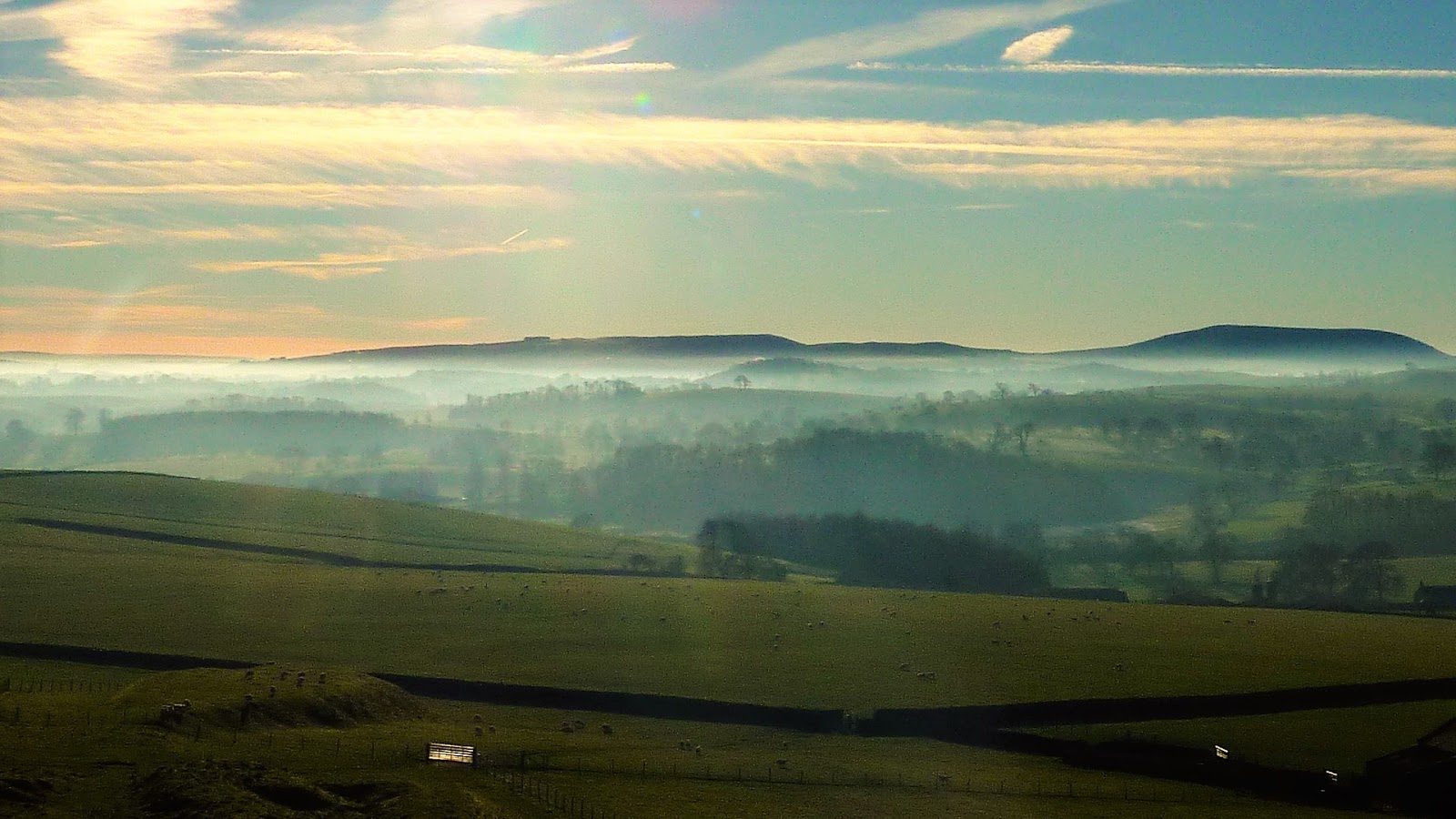
Pendle - in mist and sunshine
Enjoyed a great walk on Saturday. Starting from Gargrave, headed on to Bell Busk via Coniston Cold. Stopping for a quick sandwich on Haw Crag. All the way round, heavy mist laid in the valleys and low lying land but from the top of the Crag, Pendle Hill's summit appeared suspended between the mist and clear blue sky. A bewitching sight of such a famous hill.
Thursday, November 10, 2016
Now let us praise the President-Elect...
As politicians - mainly on the right (or very-far-right) - line up to congratulate JD Trump, here's a reminder from Auden where adulation for the abhorrent ends.
WH Auden Epitaph on a Tyrant
Perfection, of a kind, was what he was after, And the poetry he invented was easy to understand; He knew human folly like the back of his hand, And was greatly interested in armies and fleets; When he laughed, respectable senators burst with laughter, And when he cried the little children died in the streets.The prophetic voice from January 1939.
Thursday, November 03, 2016
Royal Prerogative is a funny way of delivering democracy, isn't it Mrs May?
Welcome news that the government can't trigger Art 50 behind closed doors by claiming to use the pre-civil war powers of the sovereign. Back at my law school, we learned about the power of the courts in preventing the widening of prerogative powers, in the telling phrase of Lord Diplock in BBC v Johns that it is
350 years and a civil war too late for the Queen’s courts to broaden the royal prerogative. A short, sharp reminder of the limits of the profoundly undemocratic power that the executive craves, but which judges can reign in as a defence against the untrammelled exercise of political power. The deluded Brexiters who rejoice that we've 'taken back' the country, now need to learn another lesson - that Parliament is the supreme law-maker and has the right to control the work of government ministers, particularly when they think it better to do shabby deals in closed rooms that will have a profound effect on our lives and the economy for years to come. An appeal would be most unwise...
Tuesday, November 01, 2016
55 - an age of wondrous new invitations...
Reaching 55 has led to an array of interesting offers and invitations: from hearing aid tests to pension drawdowns (Mr Osborne's special gift to the middle-aged); not to mention Michael Parkinson and his free pen and 'no questions' life insurance policy. But of far more pressing need today is the invitation to attend my local NHS hospital for bowel scope screening.
Now, don't get me wrong, colo-rectal cancer is a serious disease that affects a higher proportion of those 55 and older, but one particular aspect of it, as announced in the invitation, caused me to have a brief smile at a long-ago Viz cartoon strip.
The invitation, loving crafted on a standard NHS letterheading, came with a leaflet that explained the procedure before going on to tell me that I could watch the procedure on a monitor, if I so desired. And this is where Roger Mellie raised his head. In the late 80s cartoon, he was pitching an idea for a new TV programme - one that now seems oddly prescient. It was called Up the Celebrity Arsehole. Although he's since reprised the concept for the X-Factor judges, in the original, Mellie's idea is at first rejected as his producer tells him no celebrity would agree to be placed behind a curtain and given a stage-based colonoscopy that members of the public are then shown and the winner is the first to guess the celeb's identity. Mellie persists, however, and the final frame shows a man crouched on a table while Mellie urges 'Mr Slattery' to bend over further so they can get the camera in (reference to the ubiquitous TV personality Tony Slattery, although now TOWIE would probably provide a whole host of far keener 'celebs' willing to bend and pose.
So, this afternoon, I'm going to struggle to keep a straight face when asked if I want to see my 'performance' on screen: the revolution might not be televised, but the endoscopy very well might be - over to you Roger.
Saturday, October 29, 2016
Tricky treats
Visited my local Specsavers branch this morning to collect my new specs. I was served by a dispensing optician dressed as a witch while her boss was swanning around in full Dracula-mode. Why has the daftness of trick or treat now started to infect the grown-ups at work?
Thursday, October 27, 2016
Time in the Lakes
Got back last night from a couple of days in the Lakes. We stayed in Windermere, which I never used to like very much, mainly because of the traffic, but the hotel was clean and bright, with friendly staff.
Managed a couple of walks; on the first day the Coffin trail from Ambleside to Grasmere (where we had the obligatory afternoon tea - or coffee in my case). Then yesterday, we took an Ullswater Steamer from Pooley Bridge to Howtown and walked back on the low level, mainly lake shore path.


 From Pooley Bridge we went over to Penrith, not a town we'd visited before. A new shopping complex, the New Squares, was largely devoid of life, but home to a fair number of estate agents' signs. For a town with a fair few rather imposing squares already, the new addition seemed rather bland - cream walls in place of the traditional stone; still, with a large Sainsbury as the obvious 'anchor tenant' the local worthies obviously expect great things of the development.
After the events of the past few weeks, the break was much needed and allowed me to recharge my batteries, and I also received an email from a prospective new client, which perked me up still further. Still, it's a shame so much has been 'monetised' - 20p for a slash, with railway-style entry barriers standing sentinel at the entry to all public loos, and parking at £8.00 for anything over 4 hours, means spending time in the Lakes equates with spending a lot of money doing things that used to be free.
From Pooley Bridge we went over to Penrith, not a town we'd visited before. A new shopping complex, the New Squares, was largely devoid of life, but home to a fair number of estate agents' signs. For a town with a fair few rather imposing squares already, the new addition seemed rather bland - cream walls in place of the traditional stone; still, with a large Sainsbury as the obvious 'anchor tenant' the local worthies obviously expect great things of the development.
After the events of the past few weeks, the break was much needed and allowed me to recharge my batteries, and I also received an email from a prospective new client, which perked me up still further. Still, it's a shame so much has been 'monetised' - 20p for a slash, with railway-style entry barriers standing sentinel at the entry to all public loos, and parking at £8.00 for anything over 4 hours, means spending time in the Lakes equates with spending a lot of money doing things that used to be free.


 From Pooley Bridge we went over to Penrith, not a town we'd visited before. A new shopping complex, the New Squares, was largely devoid of life, but home to a fair number of estate agents' signs. For a town with a fair few rather imposing squares already, the new addition seemed rather bland - cream walls in place of the traditional stone; still, with a large Sainsbury as the obvious 'anchor tenant' the local worthies obviously expect great things of the development.
After the events of the past few weeks, the break was much needed and allowed me to recharge my batteries, and I also received an email from a prospective new client, which perked me up still further. Still, it's a shame so much has been 'monetised' - 20p for a slash, with railway-style entry barriers standing sentinel at the entry to all public loos, and parking at £8.00 for anything over 4 hours, means spending time in the Lakes equates with spending a lot of money doing things that used to be free.
From Pooley Bridge we went over to Penrith, not a town we'd visited before. A new shopping complex, the New Squares, was largely devoid of life, but home to a fair number of estate agents' signs. For a town with a fair few rather imposing squares already, the new addition seemed rather bland - cream walls in place of the traditional stone; still, with a large Sainsbury as the obvious 'anchor tenant' the local worthies obviously expect great things of the development.
After the events of the past few weeks, the break was much needed and allowed me to recharge my batteries, and I also received an email from a prospective new client, which perked me up still further. Still, it's a shame so much has been 'monetised' - 20p for a slash, with railway-style entry barriers standing sentinel at the entry to all public loos, and parking at £8.00 for anything over 4 hours, means spending time in the Lakes equates with spending a lot of money doing things that used to be free.
Subscribe to:
Posts (Atom)